


 sales1@lingtong-structures.com









Product Categories
Warehouse Tent
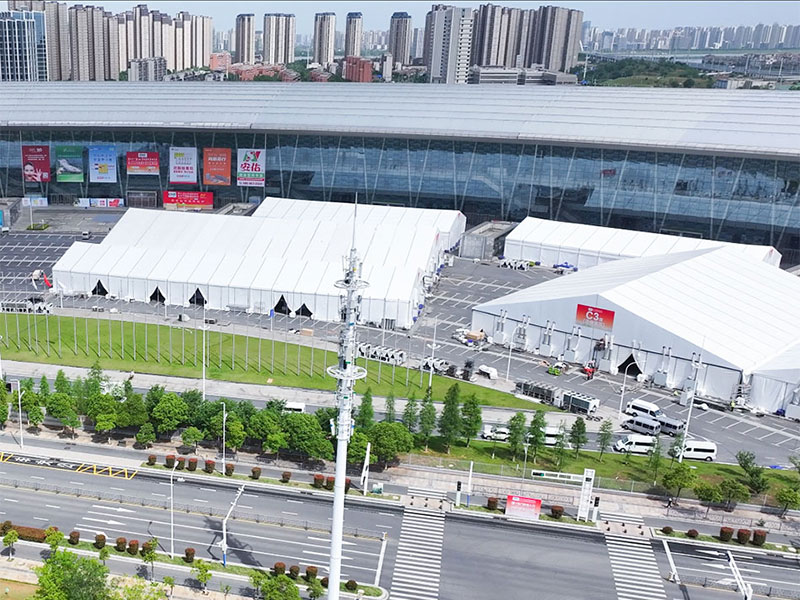
Warehouse Tent
Sports Court Tent
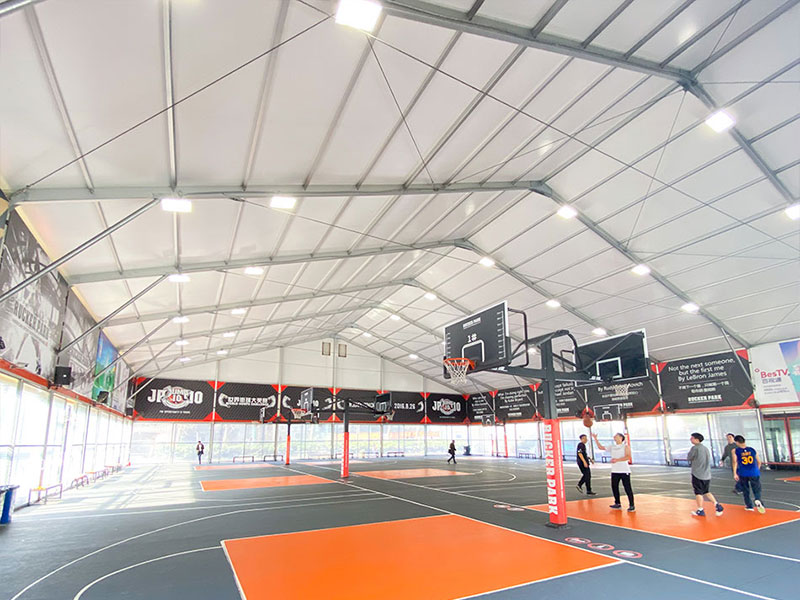
Sports Court Tent
Commercial Event Tent

Commercial Event Tent



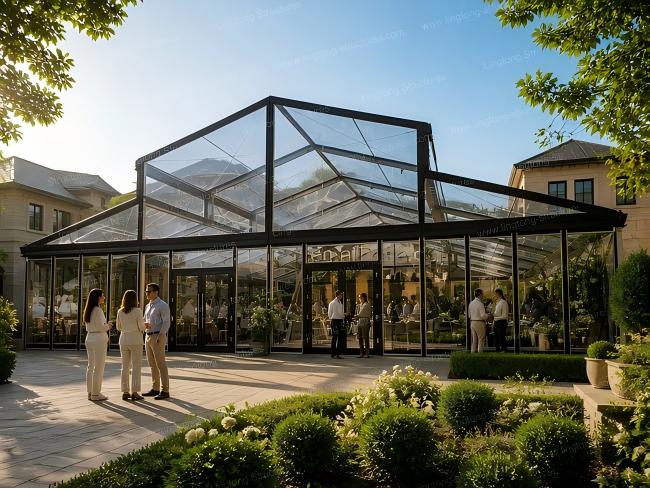
Anyone who runs banquet venues knows the problem with permanent ballrooms isn't the decor — it's that the ceiling height is fixed, the columns are fixed, the layout is fixed. Want to change it? Tear down walls and break up floors, hundreds of thousands of dollars, plus months of closure.
The atrium banquet tent works on a completely different logic. It's not a building. It's an assembled space. Need 8-meter ceilings? Done. Need 30 meters in length? Just add modules. Need to fit 25 round tables? Size it accordingly. When you're done, take it down and the ground goes back to how it was. No permanent footprint. No property tax.
This difference is more than just "no foundation required." It changes the whole operating model — from "the venue is fixed, work around it" to "design the venue around your event needs."
Common complaints about hotel ballrooms:
Low ceilings — can't do ceiling treatments, can't hang lighting high enough
Columns in the middle — some tables always have blocked views of the stage
Carpet colors never change — only so much you can do with tablecloths
Billed per session — overtime means extra charges
Atrium banquet tent advantages:
Eave height 4-8m, apex 2-3m higher — chandeliers and ceiling treatments fit easily
No columns — every seat has an unobstructed view
Flooring changes with each event type — wood, printed carpet, black mirror tiles
Purchase or long-term lease — use it as long as you want, no overtime fees
For most banquet events, the main question is how many tables fit. Atrium banquet tents are custom-sized — you don't have to work around existing space.
Standard size reference (round tables, 10 per table):
| Tent Size | Tables (10 per table) | Best For |
|---|---|---|
| 15m × 25m | 12-15 tables | Medium weddings, corporate dinners |
| 18m × 30m | 15-20 tables | Large weddings, annual galas |
| 20m × 40m | 25-30 tables | Brand dinners, events up to 1,000 guests |
Need bigger or smaller? We adjust. Span 10-40m, length extends in 3m or 5m modules with no upper limit.
Long-table banquet layouts also available. We provide CAD layouts for every event — free.
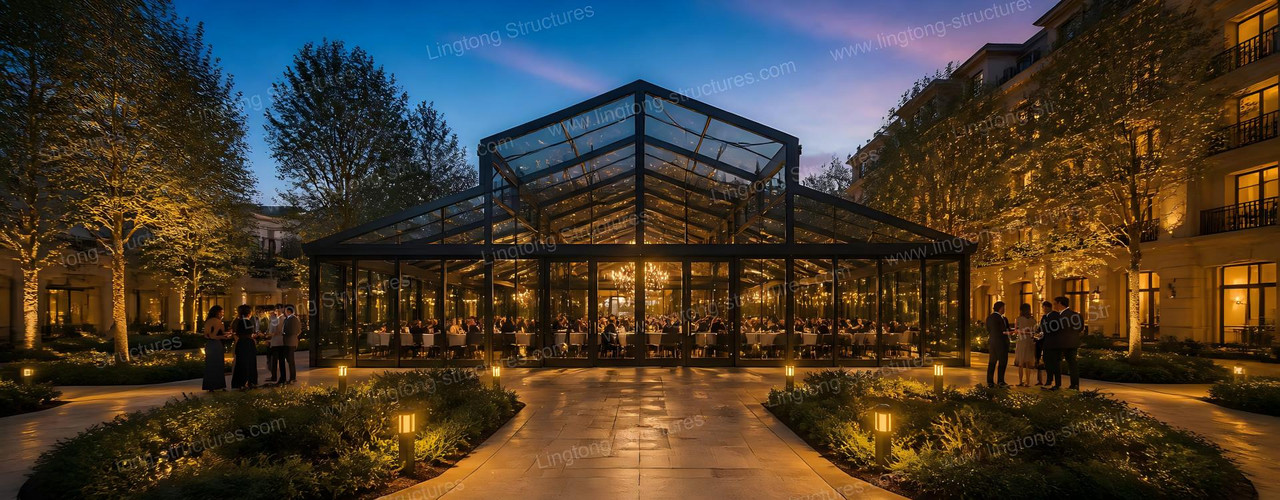
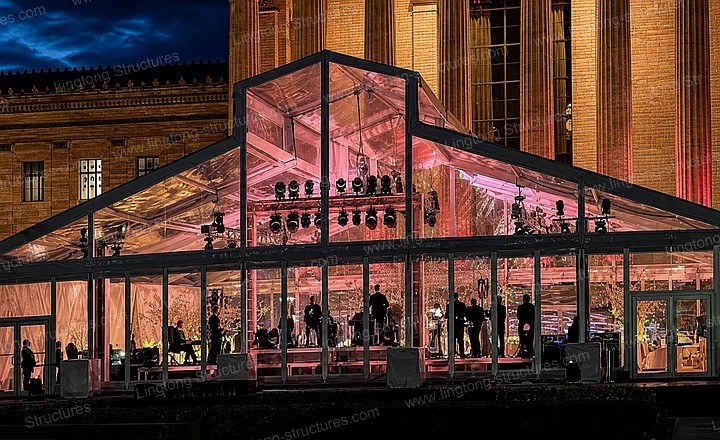
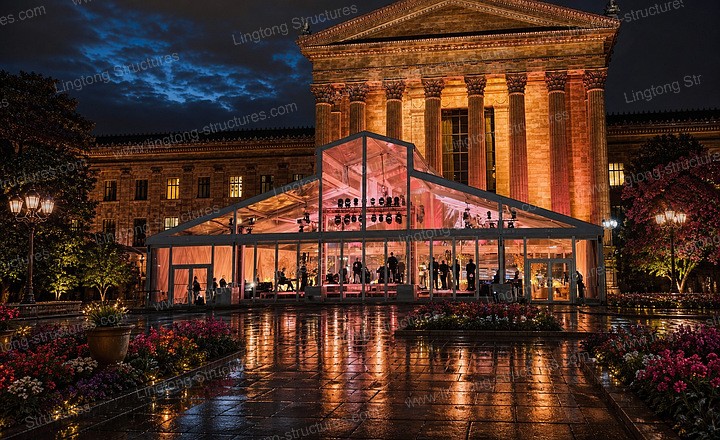
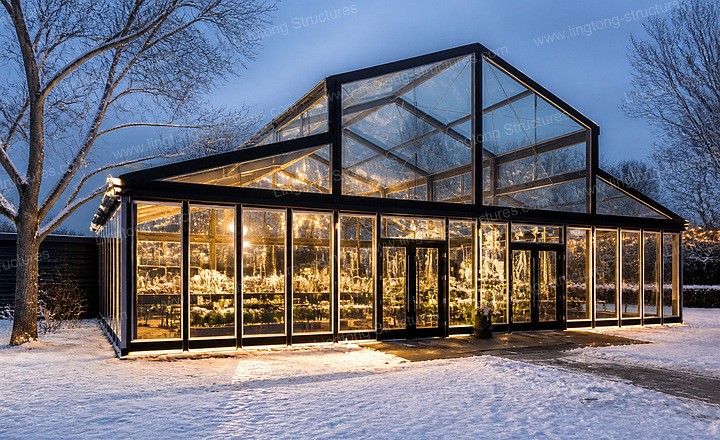
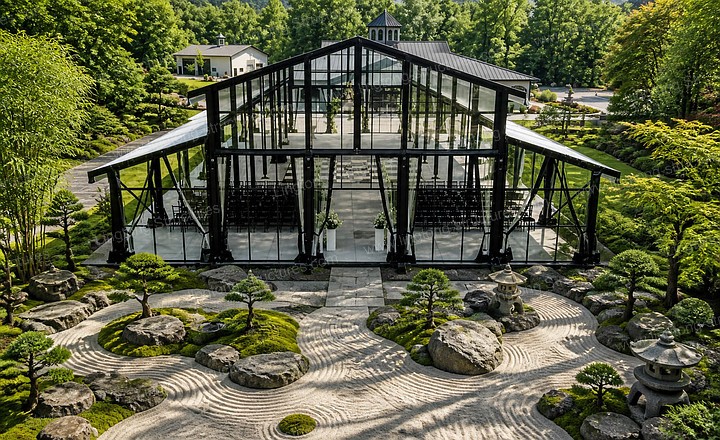
Black frame with clear glass is currently the most popular choice for banquet venues. The black lines create a strong outline against the glass, giving the structure a clean, defined look. Photos pick up reflections well, adding depth to the images.
Best suited for: brand launches, fashion dinners, high-end product showcases, beach weddings, hotel terraces, modern architecture settings. Black frames photograph better than white, making them ideal for events where visual impact and social media coverage matter.
Many event organizers worry about glass tents being too hot in summer or too cold in winter. The solutions are straightforward.
Summer cooling: Opaque roof cover (80%+ shade rate) + ventilating glass walls + industrial fans/portable AC. For larger budgets, install central air conditioning — cool air disperses from the top, reaching every seat.
Winter heating: Insulation layer (inside the roof cover) + heating equipment + double-glazed glass walls. The air gap between glass layers provides better insulation than single-pane. Interior temperature maintained at 18-22°C (64-72°F) is achievable.
Lighting: No lights needed during the day — natural light is evenly distributed, photos don't need filters. Evening and night use LED string lights for ambiance with chandeliers as main lighting. A lighting control system adjusts brightness and color temperature — the same space can look completely different before and after dinner.
Event venue setup is often constrained by tight deadlines. The modular tent system gives you precise control over the schedule.
Concrete buildings take years from foundation to completion. Atrium tents take 15-25 days for production and 3-7 days for on-site installation. For events that need to hit a specific date, this time advantage is significant.
Lingtong Tent has been in the aluminum tent industry for 29 years. Not many manufacturers in this space have been around that long.
Our factory is in Changzhou, Jiangsu, covering 20,000㎡. Every step — aluminum extrusion, surface treatment, CNC machining, fabric cutting, high-frequency welding — is done in-house. No white-labeling, no middleman markup.
What does 29 years of experience actually mean? It means we know how to design for different climates — the same span needs different material specs for coastal vs. inland locations. The same fabric has different service life in arid Middle Eastern conditions vs. humid Southeast Asia. The same event requirements face different compliance standards in different countries.
ISO9001 and CE certified. Products exported to over 200 countries. Spare parts available at cost for life. These are the basics.
How far in advance should I book a tent for an event?
We recommend 45-60 days ahead. Production takes 15-25 days, installation 3-7 days, leaving time for interior setup and rehearsals. Peak seasons (May-June, September-October) require earlier booking.
How are lighting and sound handled inside?
The aluminum frame has pre-fitted mounting points for lighting and sound equipment. Chandeliers, LED string lights, and speakers can all be directly mounted on the frame — no welding or drilling needed. Load capacity is structurally calculated for safety.
What's the quality difference between an atrium banquet tent and a fabric event tent?
Fabric tents have PVC side walls — it feels like walking into a temporary shelter. Atrium tents have glass walls — it feels like walking into a glass house. Photos taken inside glass tents look completely different from those under PVC lighting, and guests notice the difference. From an operator's perspective, glass tents can command 1.5 to 2 times the price point of fabric tents.
How is the floor handled? Can you put carpet directly on grass?
Yes, but lay a moisture barrier underneath first to prevent ground moisture from seeping up. For long-term venues (1+ years), wood flooring is recommended — it feels better underfoot and looks more premium. When you move, the flooring can be taken with you.
Can the tent be resold after years of use?
Yes. The aluminum frame and glass walls retain residual value. They can be sold as used equipment when dismantled. Permanent buildings become demolition waste that you pay to remove. A tent that can be dismantled and sold is an asset many venue operators factor into their long-term planning.




 Inquire Now