


 sales1@lingtong-structures.com





Product Categories
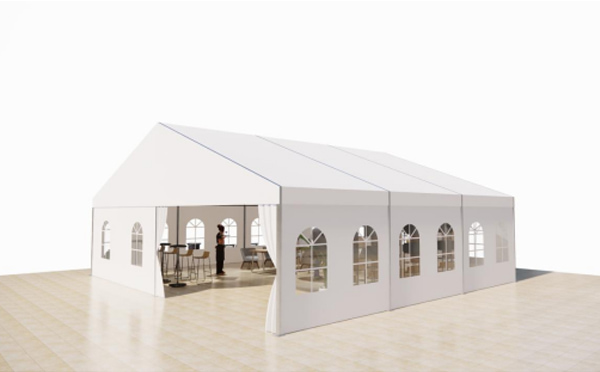
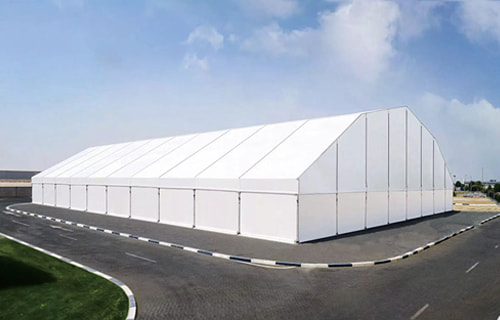
Warehouse Tent
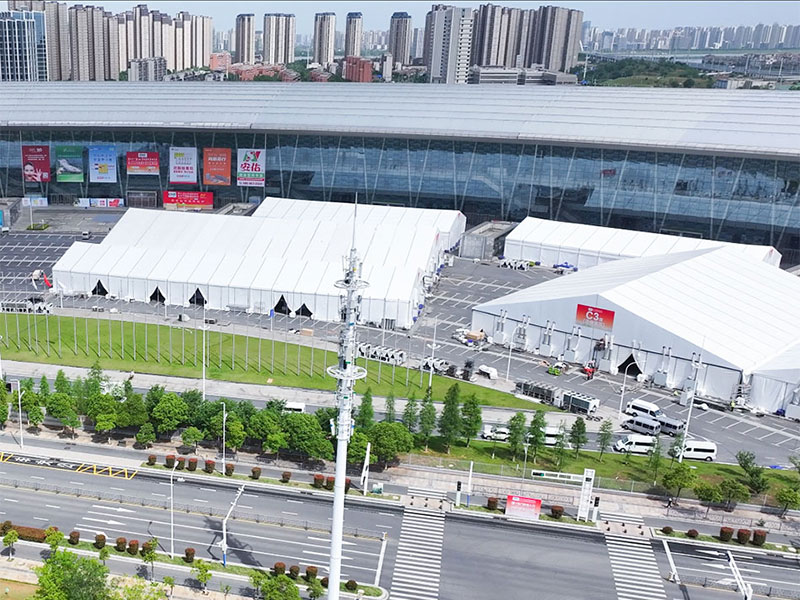
Warehouse Tent
Sports Court Tent
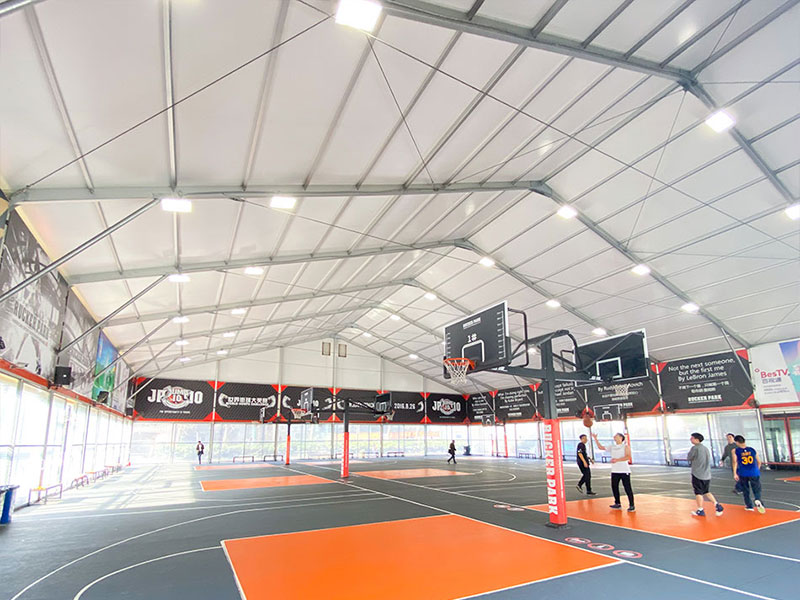
Sports Court Tent
Commercial Event Tent

Commercial Event Tent



There are a few key aspects worth noting about this product: the convenience of the scissor‑fold retractable structure, the durability advantage of aluminum over steel tubing, and the different use cases compared to fixed storage tents.
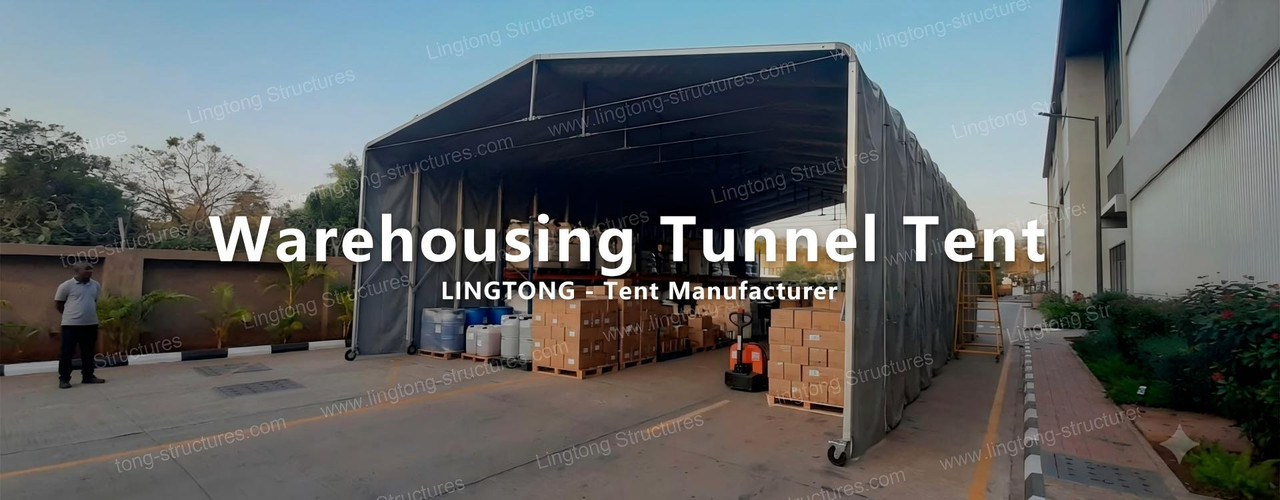
The extension and retraction rely on a scissor‑fold mechanism – much like an accordion. Pull it out to extend, push it back to fold. The bottom is fitted with wheels or a track system, so one person can move it, and two people make it even easier.
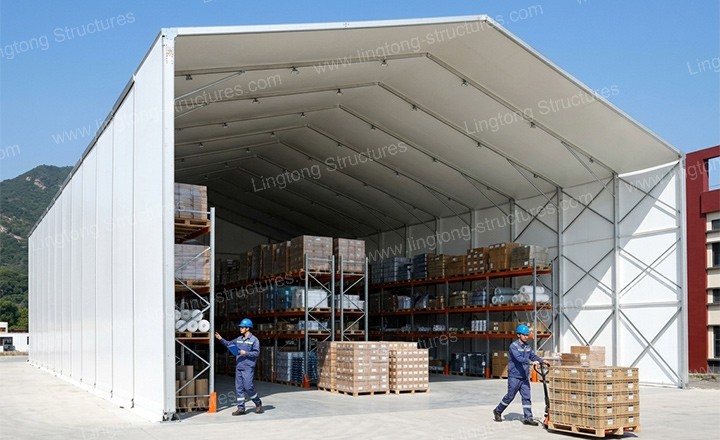
This design gives the retractable tunnel tent a completely different use case compared to a fixed tent: when extended, it is a full warehouse; when retracted, it becomes a folded frame that sits flat against a wall, freeing up all the space it previously occupied. No parking blocked, no goods in the way, no access obstructed – and when you need it, it takes just 3‑5 minutes to pull out and put to use.
For storage‑use retractable tents, the frame material determines the overall service life of the equipment.
Cheap steel‑tube canopies on the market are prone to rust at the welds, and the thin walls deform easily – problems start appearing within two years. The aluminium frame, by contrast, does not rust, is lightweight, and has high strength. For the same span, aluminium is much lighter than steel, making it easier to pull and push, while the frame itself is far more durable.
The frame uses high‑strength aluminium alloy profiles with an anodised surface treatment, resistant to coastal humidity and rainy seasons. The aluminium frame can last 15‑20 years – when the cover eventually wears out, you simply replace the cover while the frame stays in place.
A fixed storage tent stays in place permanently; a retractable tunnel tent can be retracted and extended as needed. The differences come down to:
Footprint – fixed tents take up space permanently; retractable tents take up no space when not in use. For factories and logistics parks with tight space, freeing up that area is a real benefit.
Frequency of use – fixed tents suit long‑term, stable storage needs; retractable tents suit intermittent use. If you need storage every day, a fixed tent is more convenient. If you only need it a few times a month, the retractable tent is the smarter choice.
Cost structure – for the same area, the retractable tent costs slightly more upfront because of the moving parts and track system. But if you factor in the value of the space freed up when it is not in use, the total long‑term cost of the retractable tent is actually quite competitive.
The storage retractable tunnel tent is genuinely useful in one specific situation: when your storage needs are intermittent, not daily.
Factory loading bay canopy – loading and unloading goods in rain or sun. Set up the retractable tent above the bay; extend it during loading, retract it afterwards so it does not block access. In this scenario, the retractable tent is much more practical than a fixed tent – a fixed tent would obstruct truck movement, while the retractable tent does not.
Temporary material storage – when extra materials or newly arrived goods cannot be moved into the main warehouse straight away, extend the tent on an open area for temporary storage. When that batch is done, retract it – no need to set aside a permanent space.
Seasonal storage – some industries only have peak demand for a few months. The retractable tent is used during the busy season and stored away in the off‑season, offering much more flexibility than renting a fixed warehouse.
Shopfront shelter – for restaurants and retail stores, install a retractable tent at the entrance to keep customers dry on rainy days, and retract it when not needed to keep the storefront clear.
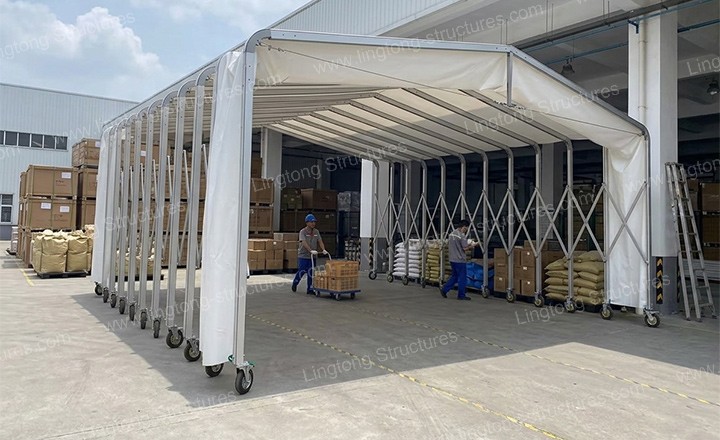
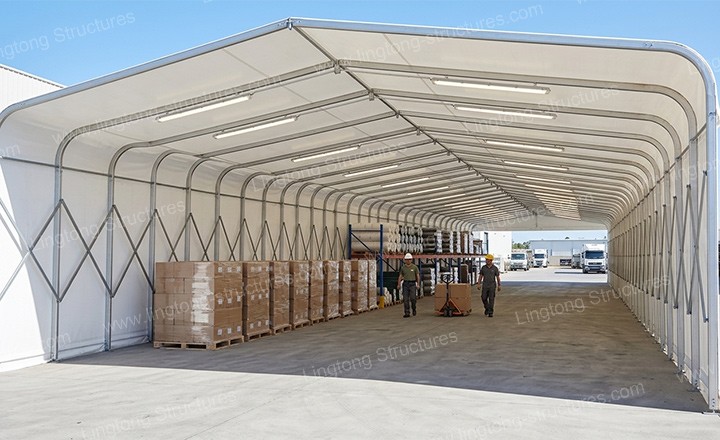
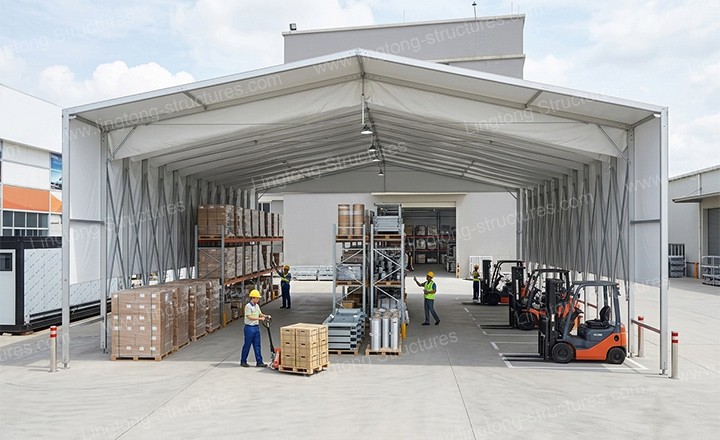
Braked swivel castors – lock in place once positioned, no unwanted movement
Electric extension system – extend and retract at the touch of a button, ideal for larger sizes or frequent use
Side wall curtains – fully enclose the space for complete storage; the side fabric can be detached independently
Lighting system – for night‑time interior work
Custom cover printing – apply your company logo or signage
Track system – ensures smooth operation on uneven ground
| Item | Specification |
|---|---|
| Frame Material | High‑strength aluminium alloy, anodised |
| Cover Material | 850g/㎡ double‑sided PVC knife‑coated fabric, waterproof, flame‑retardant, UV‑resistant |
| Span Range | 3‑15 meters (customisable) |
| Extended Length | Customised to requirements |
| Extension Mechanism | Scissor‑fold structure, manual / electric |
| Frame Service Life | 15‑20 years |
Lingtong Tent has been in the aluminium tent industry for 29 years. Our factory is in Changzhou, Jiangsu, covering 20,000㎡. From aluminium extrusion and surface anodising to fabric cutting and welding, everything is done in‑house. Products are exported to over 200 countries and regions. As one of our product lines, storage retractable tunnel tents are built to the same standards as our aluminium tents – no compromise on quality.
Retractable tent manufacturing is not particularly high‑tech, and there are many suppliers on the market with varying levels of quality. The real differences come down to frame material and build detail – aluminium vs steel tube, fabric weight, smoothness of the wheels, and quality of the welds.
Q: Which is more cost‑effective – a retractable tunnel tent or a fixed tent?
A: It depends on how often you need it. If you need it every day, a fixed tent is better value. If you only need it a few times a week or month, the retractable tent is more economical because you free up the space when it is not in use.
Q: How much more expensive is an aluminium retractable tent than a steel‑tube one?
A: It costs more upfront. But a steel‑tube canopy will rust and deform within two or three years, whereas the aluminium frame lasts over a decade. Over time, the aluminium version actually works out cheaper – and you avoid the annual rust‑proofing and repainting costs.
Q: How wind‑resistant is the retractable tunnel tent?
A: The aluminium frame is stronger than ordinary steel‑tube canopies, but a retractable tent is a movable structure, not a permanent building. In high winds, it is best to retract it – the folded position is the safest. For locations with frequent strong winds, contact us to assess a reinforced solution.
Q: Can it be installed on uneven ground?
A: Uneven ground can affect smooth operation. We recommend installing a track system to level the surface, or using it on flat ground. Not sure? Send us a photo of your site and we will advise.
Q: Can the cover be replaced if it gets damaged?
A: Yes. The cover is independently fixed to the frame, so if it wears out or gets torn, you can replace just the cover – the frame stays in place.




 Inquire Now