
 sales1@lingtong-structures.com











Sports Tent Lighting Glare Problems We Have Proven Solutions
 Sep 02, 2026|
 View:131
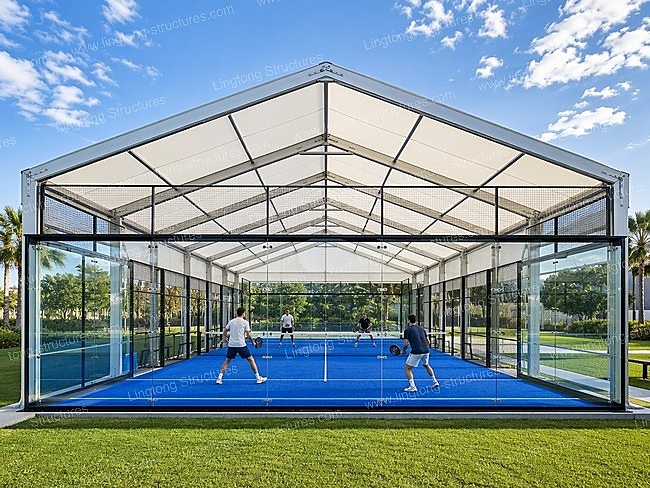
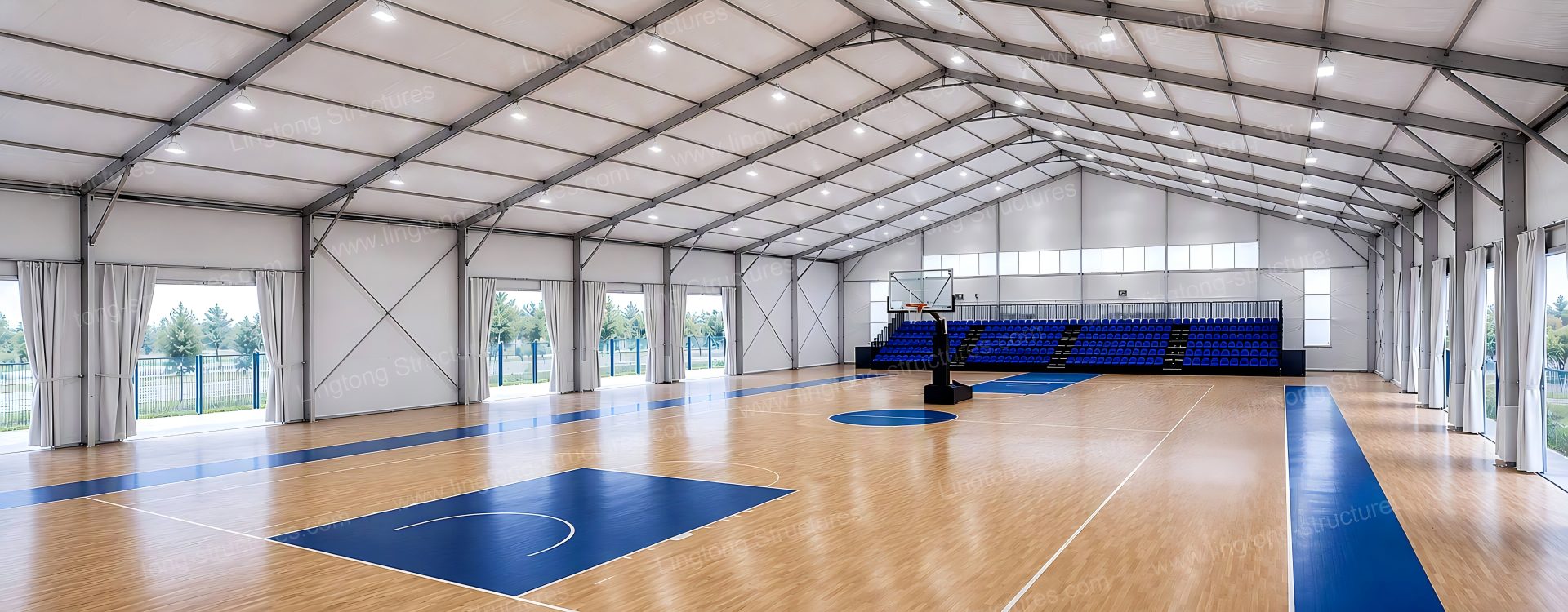 The lights are installed, but players say "it's too bright, I can't see the ball." This is one of the most frustrating problems in sports tents.
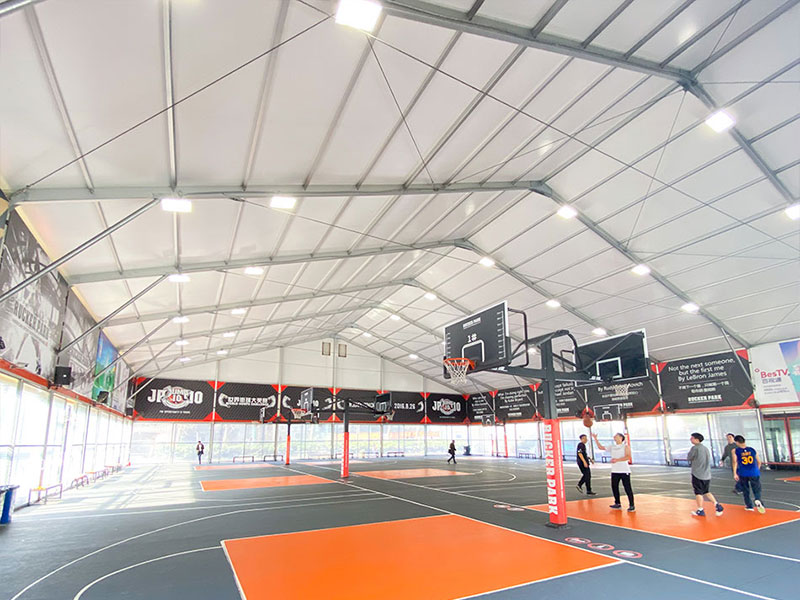
Glare is common in sports venues, but controlling it in sports tents is more complex than in permanent buildings. Low eave heights, reflective roof membranes, and limited mounting points all make light control significantly harder.
Real Problems We See from Clients
In the sports tent projects we've worked on, glare issues typically show up in three ways:
Player complaints are the most direct feedback. Sports like badminton, volleyball, and basketball require players to look upward frequently. When fixtures are poorly positioned or lack anti-glare treatment, players get blinded the moment they look up, leading to misjudgments. Training quality suffers, and match fairness is questioned.
Poor broadcast quality is the second common issue. Many venues install cameras for live streaming or recording, but poor lighting leaves players' faces dark while the background is overexposed. Post-production becomes unusable.
Operators making reactive adjustments is the third problem. When complaints pile up, venues end up turning off some lights. Illuminance drops from 500 lux to below 300 lux. The court gets darker, but the glare problem isn't actually solved. Lights on—too harsh. Lights off—too dark. No good option.
These problems can't be solved by swapping bulbs. Fixture selection, placement, and shielding design—all three must be done right to eliminate glare entirely.
What We Actually Do for Sports Tent Lighting
Our approach to sports tent lighting is straightforward: start with standards, execute with precision on site, and verify with actual testing.
Standards first. We design based on EN 12193 and EN 12464-1. The general requirement for indoor sports halls is UGR ≤ 22, with illuminance between 300 and 500 lux. We set our target at UGR below 19—stricter than the standard requires. This gives a larger safety margin and means the venue won't need a lighting overhaul if it upgrades to host competitions later.
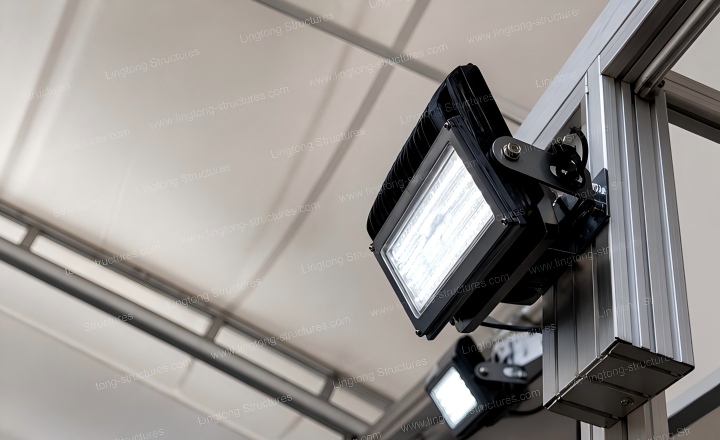
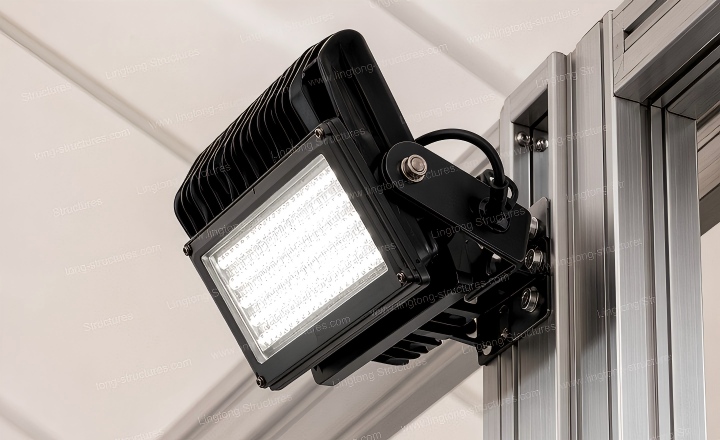
Fixture selection. We use LED sports-specific fixtures with UGR below 19, equipped with anti-glare louvers and precision optics. High efficacy, color rendering index Ra ≥ 80. Color temperature is standardized at 4000K to 5000K to ensure all lights match.
Placement optimization. Fixtures are arranged along the sides of the court using asymmetric optics, avoiding direct installation directly above players' line of sight. Shielding angles are adjusted based on actual eave height and ridge height, ensuring light is precisely directed onto the court rather than scattering into players' eye level.
Ceiling shielding treatment. PVC membrane is naturally translucent. Light hitting the ceiling creates secondary diffuse reflection. We factor in the membrane material and light transmittance during the design phase, coordinating the fixture shielding to prevent ceiling reflection from becoming an additional glare source.
On-site testing validation. After installation, we run on-site illuminance and UGR testing. All projects come with a test report on file.
Real Project Cases
Case 1: University badminton hall. Eave height 6 meters, ridge height 9 meters, four standard courts. Original lighting used standard LED industrial fixtures. Players complained about glare when looking up, and training efficiency dropped. We redesigned the layout and replaced them with anti-glare sports-specific fixtures. UGR dropped from above 22 to 17. Feedback after installation: "We can see the ball clearly now, and our eyes don't get tired."
Case 2: Community basketball tent. Span 30 meters, eave height 6.5 meters. The operator's main issue was overexposed broadcast footage—players' faces lost detail, and live streams looked poor. We adjusted fixture positions and angles, added anti-glare louvers, and did targeted fill lighting to work with the camera positions. After the upgrade, the footage was usable.
Case 3: Multi-sport training center. Same tent used for badminton during the day and basketball at night. Different sports have different lighting needs. We installed a dimming system with scene presets: 500 lux with UGR 17 for daytime, 300 lux with UGR 16 for nighttime. One venue, two lighting plans, switchable as needed.
These cases are based on projects where site conditions were suitable, budgets adequate, and installation coordination in place. Actual results vary based on eave height, membrane transmittance, and available mounting points. Each project requires a tailored design—there's no one-size-fits-all template.
Our Principles for Sports Tent Lighting
EN 12193 and EN 12464-1 are our baseline. We target UGR below 19—stricter than the standard.
Every tent has different dimensions, eave heights, and membrane materials. We design for the actual conditions—no cookie-cutter templates.
Installation isn't the finish line. We run illuminance distribution testing and UGR verification before handover, ensuring the results match the design targets.
Frequently Asked Questions
Q: How do you handle ceiling reflection from PVC membranes?
A: The membrane is naturally translucent, and light hitting it creates secondary diffuse reflection. We control this through double-layer membrane combined with targeted fixture shielding, with adjustments made during design based on the actual membrane material and light transmittance.
Q: Is the dimming system standard or optional?
A: Dimming systems and scene presets are standard in our solutions. A single venue may be used for training, matches, or events—each with different lighting requirements. Dimming allows one fixture setup to serve multiple use cases.
Q: Do you provide test reports upon delivery?
A: Yes. Every project includes on-site illuminance and UGR testing before handover, with a test report provided. What we deliver isn't just a set of lights—it's a verified lighting solution.
Q: Is maintenance difficult later?
A: LED sports fixtures typically have a lifespan of 50,000+ hours. Anti-glare louvers and shields are separate components and can be replaced individually.
If you're planning or upgrading lighting for a sports tent, send us your site dimensions, eave height, and usage requirements. We'll do an initial glare risk assessment and proposal for your reference.
Recent News
1.LINGTONG Structures: Premier Aluminum Modular Clear-Span Tent Solutions for Warehousing, Sports, and Exhibitions
2025-01-032.Why You Need a Tent for Sporting Events?
2025-10-153.Saudi Arabia Sports Event Tent Project | Temporary Solution
2026-02-264.Sports Tent A Flexible and Efficient Multi-Purpose Sports Venue Solution
2026-07-10