


 sales1@lingtong-structures.com











What is a heavy duty industrial tent and its common uses?
 Sep 01, 2026|
 View:129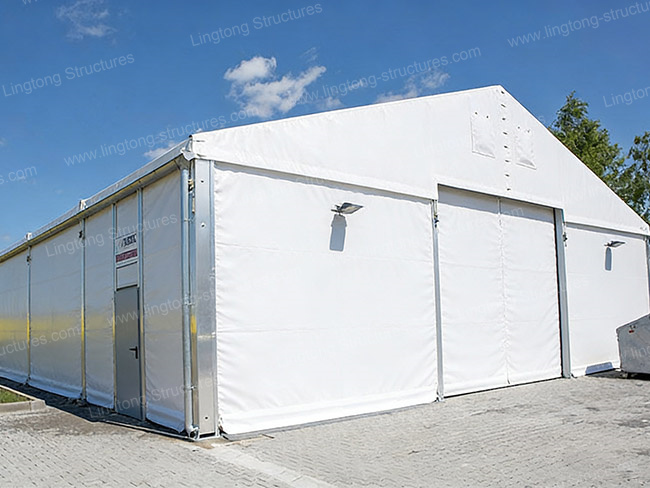
Introduction: The Industrial Space Solution You've Been Looking For
Imagine needing additional warehouse space—not in six months, but in three weeks. Or picture a mining operation in a remote location where traditional construction is simply not feasible. These are the scenarios where a heavy duty industrial tent becomes not just an option, but the only practical solution.
A heavy duty industrial tent is far more than a simple canopy or party tent. It is an engineered structure built to withstand extreme weather, heavy loads, and the rigorous demands of industrial operations. From storing heavy machinery to housing manufacturing assembly lines, these structures provide the durability of a permanent building with the flexibility of a temporary solution.
This guide explains what a heavy duty industrial tent is, examines its key specifications, and explores the seven most common applications across industries.
Part 1: What Exactly Is a Heavy Duty Industrial Tent?
A heavy duty industrial tent is a professional-grade, engineered temporary or semi-permanent structure specifically designed for commercial and industrial applications. Unlike recreational or event tents, these are built with materials and engineering standards that rival permanent structures.
Core Components of a Heavy Duty Industrial Tent
1. The Frame: The Structural Backbone
The frame of a quality heavy duty industrial tent is constructed from 6061-T6 aluminum alloy—the same material used in aerospace applications. This alloy offers an optimal strength-to-weight ratio, excellent corrosion resistance, and remarkable durability. Leading manufacturers like Lingtong design their industrial tents with heavy-duty aluminum alloy frames capable of withstanding wind loads up to 120 km/h.
Key frame specifications to look for:
Material: 6061-T6 or 6082-T6 aluminum alloy
Tensile strength: Exceeding 275 MPa
Corrosion protection: Anodization coating (minimum 10μm)
Service life: 15–25 years with proper maintenance
2. The Cover: The Protective Barrier
The fabric covering a heavy duty industrial tent is equally critical. High-quality tents use double-layer PVC-coated polyester fabric with minimum specifications of 850 g/m².
Key fabric specifications:
Material: Double-side PVC coating
Weight: 850 g/m² or higher
Waterproof rating: Exceeding 3000 mm water column pressure
UV resistance: UPF50+
Fire retardancy: B1 class (DIN 4102) or equivalent
3. The Design: Clear-Span Engineering
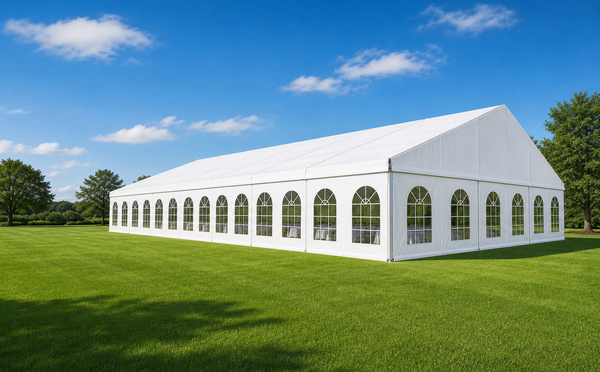
Perhaps the most important design feature of a heavy duty industrial tent is its clear-span construction. This means the structure has no interior support columns, providing 100% usable floor space. Available widths range from 10 to 50 meters, with unlimited length options.
4. The Certification: Safety Validation
A legitimate heavy duty industrial tent carries independent safety certifications. The most important is EN 13782, the European standard for temporary structure safety covering wind and fire resistance. Additional certifications to look for include DIN 4102 B1 for fire safety and ISO 9001 for manufacturing quality.
5. The Assembly: Rapid Deployment
Unlike traditional construction that takes months, a heavy duty industrial tent can be assembled in days. High-quality systems can achieve 500 square meters of assembly in under 4 hours.
Part 2: 7 Common Uses for Heavy Duty Industrial Tents
1. Industrial Warehousing and Storage
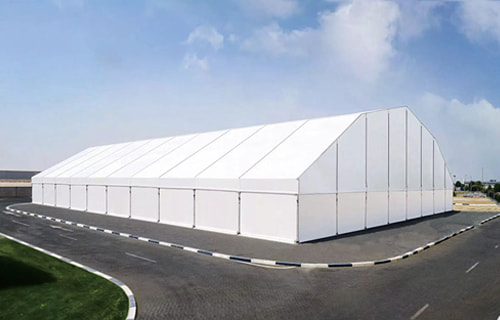
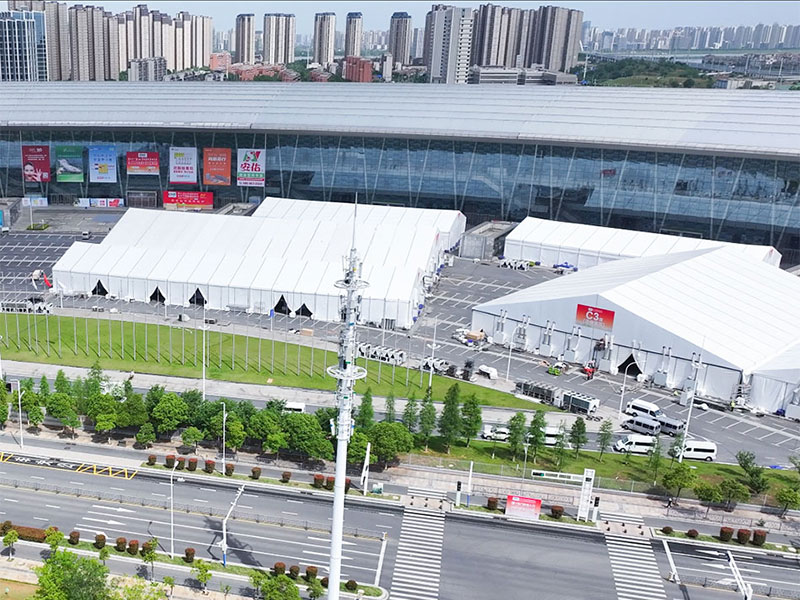
The most widespread application of heavy duty industrial tents is warehousing. Businesses use them for:
Temporary overflow storage during peak seasons
Semi-permanent warehouses for long-term inventory
E-commerce fulfillment centers requiring rapid expansion
A heavy duty industrial tent provides a cost-effective alternative to traditional warehouses, with construction costs typically 40–70% lower per square meter.
2. Manufacturing and Production Expansion
Manufacturing facilities frequently use heavy duty industrial tents to:
Expand production capacity without halting existing operations
House assembly lines for new product launches
Create temporary workshops for specialized projects
The modular design allows manufacturers to scale space up or down as production demands fluctuate.
3. Mining Operations
Mining is one of the most demanding environments for any structure, and heavy duty industrial tents excel in these conditions:
Equipment storage for trucks, excavators, and drills
Material stockpiling with column-free access
Maintenance shelters for on-site repairs
Worker facilities including lunch and rest areas
4. Construction Sites
Construction projects benefit from heavy duty industrial tents in multiple ways:
Temporary warehouses for steel, cement, and building materials
On-site offices and project management centers
Equipment protection from weather elements
Material staging areas for efficient workflow
These structures can be installed on various ground types, including soft and uneven surfaces, with minimal groundwork required.
5. Aviation Hangars
The clear-span design of a heavy duty industrial tent makes it ideal for aviation applications:
Aircraft storage and maintenance hangars
Temporary terminal facilities for events or emergencies
Equipment housing for ground support operations
Some heavy-duty industrial hangar tents offer clear-span interiors of up to 80 meters, accommodating large aircraft with ease.
6. Sports Facilities
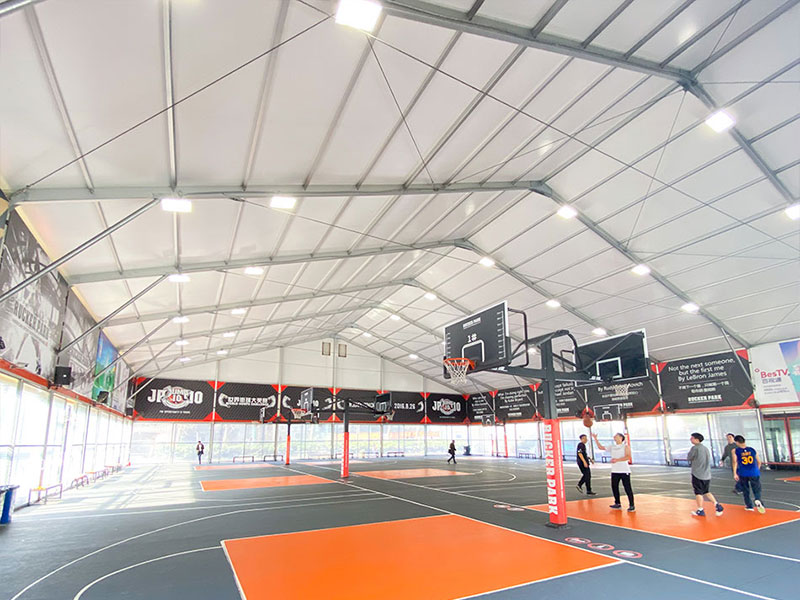
Heavy duty industrial tents increasingly serve as sports venues:
Indoor training facilities for year-round practice
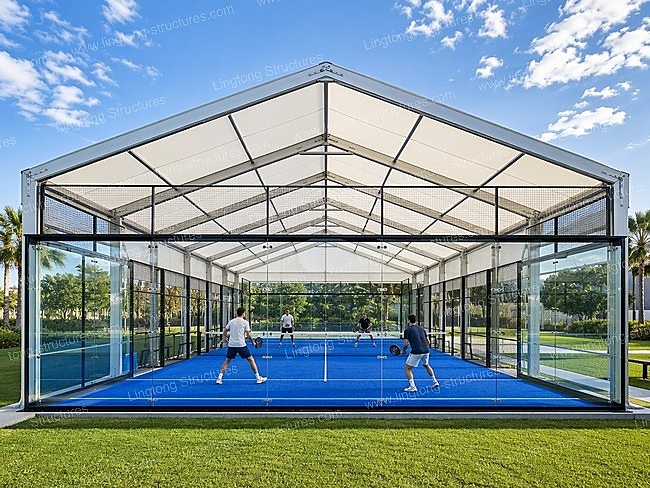
Tennis and padel court covers with uninterrupted play space
Multi-sport complexes with modular interior solutions
The durable aluminum construction provides clean, column-free spaces available in widths from 10 to 50 meters.
7. Emergency Response and Disaster Relief
When disasters strike, speed is critical. Heavy duty industrial tents provide:
Emergency shelters for displaced populations
Temporary medical facilities for field hospitals
Supply distribution centers for relief operations
Command centers for emergency management
These structures can be rapidly deployed in emergency situations, providing immediate protection for people and assets.
Part 3: Heavy Duty Industrial Tent vs. Traditional Building Comparison
| Comparison Factor | Heavy Duty Industrial Tent | Traditional Building |
|---|---|---|
| Cost per square meter | 40–70% lower | Higher initial investment |
| Construction timeline | Days to weeks | 6–12 months |
| Foundation requirements | Minimal; installs on various ground types | Extensive site preparation |
| Expandability | Modular; easy to add sections | Complex, costly expansion |
| Relocatability | Fully relocatable and reusable | Permanent; cannot be moved |
| Frame service life | 15–25 years | 40+ years |
| Recyclability | 100% recyclable aluminum frame | Limited recyclability |
| Permitting complexity | Streamlined process | Extensive permits and approvals |
| Interior supports | None (clear-span design) | Often requires columns |
| Weather resistance | 120 km/h wind, snow certified | Variable by design |
Part 4: Key Specifications to Look for in a Heavy Duty Industrial Tent
When evaluating a heavy duty industrial tent, consider these critical specifications:
Wind Load Capacity
Standard specification: 80–100 km/h verified by static analysis
High-performance models: Up to 120 km/h
Snow Load Capacity
Standard specification: 12 cm verified by static analysis
Customizable for extreme climate regions
Frame Material
6061-T6 or 6082-T6 aluminum alloy
Anodization coating: Minimum 10μm
Galvanization of steel parts: Minimum 60μm
Fabric Specifications
Double-side PVC coating
Minimum 850 g/m² weight
Fire retardant: B1 class or equivalent
Certifications
EN 13782: Fire and wind resistance
DIN 4102 B1: Fire safety
ISO 9001: Quality management
Frequently Asked Questions
Q1: What is the difference between a heavy duty industrial tent and a regular event tent?
A: A heavy duty industrial tent uses aerospace-grade aluminum frames (6061-T6), 850+ g/m² double-PVC fabric, and carries EN 13782 certification for wind and fire resistance. Regular event tents use lighter materials and lack industrial-grade engineering and certifications.
Q2: How long does a heavy duty industrial tent last?
A: The aluminum frame typically lasts 15–25 years with proper maintenance. The PVC fabric cover generally needs replacement every 5–8 years depending on climate and UV exposure.
Q3: Can a heavy duty industrial tent withstand extreme weather?
A: Yes. Quality tents are engineered for wind loads up to 120 km/h and certified snow loads. They can operate in temperatures ranging from -40°C to +70°C.
Q4: Is a heavy duty industrial tent cheaper than a traditional warehouse?
A: Significantly. A heavy duty industrial tent typically costs 40–70% less per square meter than a traditional pre-engineered metal building, with construction times measured in days rather than months.
Q5: Can a heavy duty industrial tent be moved to a new location?
A: Yes. The modular aluminum frame design allows for easy disassembly, transport, and reassembly at new sites. This makes it a portable asset rather than a fixed investment.
Q6: What certifications should I look for in a heavy duty industrial tent?
A: Essential certifications include EN 13782 (temporary structure safety for wind and fire), DIN 4102 B1 (fire retardancy), and ISO 9001 (manufacturing quality management).
Q7: Can heavy duty industrial tents be customized for specific needs?
A: Yes. They can be fully customized in size, layout, wall systems (ABS, fabric, glass, insulated panels), and features to meet specific industrial requirements.
Q8: What types of ground can a heavy duty industrial tent be installed on?
A: They can be installed on various ground types, including concrete, asphalt, compacted gravel, and even soft or uneven surfaces, with minimal groundwork required.
Conclusion: Why a Heavy Duty Industrial Tent Makes Business Sense
A heavy duty industrial tent represents a strategic alternative to traditional construction for businesses facing space challenges. The combination of rapid deployment, significant cost savings, and exceptional durability makes these structures increasingly attractive across industries.
The business case for a heavy duty industrial tent:
Capital efficiency: 40–70% lower upfront costs preserve capital for core operations
Speed to market: Days instead of months means faster operational readiness
Flexibility: Modular design allows expansion, reduction, or relocation as needs change
Sustainability: 100% recyclable aluminum frames support environmental goals
Safety: EN 13782 certification ensures structural integrity
For businesses in warehousing, manufacturing, mining, construction, aviation, sports, or emergency response, the heavy duty industrial tent offers a proven, reliable solution.
Ready to explore the right heavy duty industrial tent for your operation?
Lingtong Exhibition Tent is a leading manufacturer of heavy-duty industrial tents with over two decades of industry experience. Our industrial tents feature:
6061-T6 aluminum alloy frames with 120 km/h wind resistance
EN 13782 fire and wind certification for safety assurance
15+ year frame service life with 100% recyclability
Rapid assembly: 500 square meters in under 4 hours
Comprehensive one-stop service: From design and manufacturing to installation and after-sales support
Our dedicated team of experienced engineers, designers, and production staff provides customized solutions for warehouses, sports facilities, mining operations, and more.
Contact Lingtong Exhibition Tent today to discuss your heavy duty industrial tent requirements. Request a free quote, technical documentation, or a consultation with our engineering team. Let us help you find the perfect industrial space solution for your business.