


 sales1@lingtong-structures.com











40 Years of Aluminum Tents What We've Observed in the Padel Industry
 Jul 20, 2026|
 View:268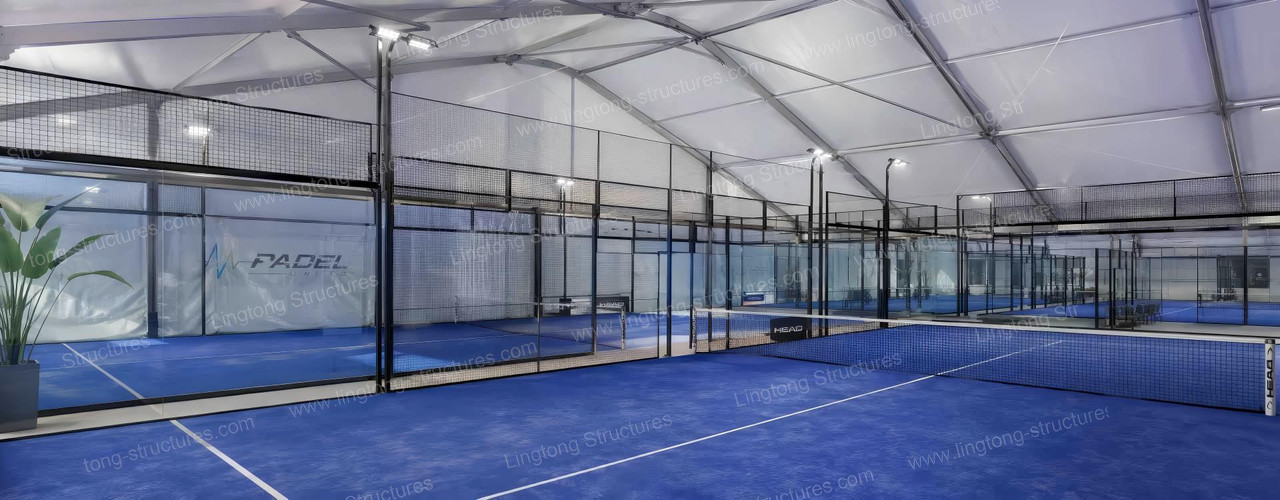
The European padel market has undergone significant changes in recent years. Three years ago, rapid expansion and securing venues was enough to generate profits. Today, operators are more focused on court utilization rates, member retention, and operational costs.
With 40 years of experience in aluminum sports tents, our team at Lingtong has worked with numerous club owners across Europe. One clear trend is that the definition of a "good venue" is becoming increasingly diverse.
Some insist on open-air courts, citing the irreplaceable benefits of natural light and ventilation. Others only consider fully enclosed structures to ensure uninterrupted play during rainy seasons. Many find themselves in the middle—concerned that simple tents lack durability, yet finding traditional construction too slow and expensive.
We won't judge which option is superior. Instead, we'll share observations from different climate regions and projects.
How Much Revenue Is Lost to Weather? Data from Real Operations
A five-court club in Western Europe charges €40 per hour during peak times. With ten hours of full booking daily, the theoretical maximum daily revenue is €2,000.
During the rainy season, an average of 12 days per month see empty courts. This results in a monthly loss of €24,000, or €72,000 per quarter.
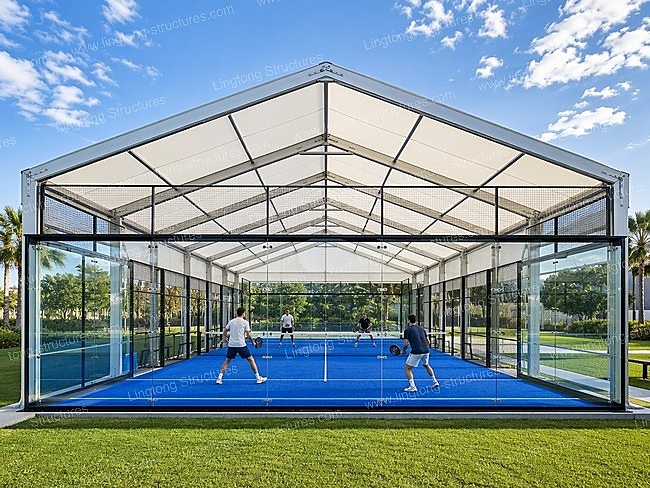
Some owners accept this as a norm. However, a growing number are choosing to cover their courts with aluminum structures, effectively removing weather from their operational equation.
Enclosing courts does introduce new costs—lighting, ventilation, and winter heating. However, based on projects we've tracked, most operators find the overall returns more stable with an enclosed solution over a 3-to-5-year period.
What's the Difference Between a Storage Tent and a Professional Padel Tent?
While there are many low-cost tents on the market, a true professional padel tent is vastly different from temporary storage units.
Sound Management
Padel generates significant noise. Single-layer PVC fabric bounces sound around, creating an unpleasant echo. This affects the playing experience and, consequently, retention rates.
Our solution uses a double-layer roof with specific PVC tension, which noticeably reduces echo. Players can converse normally on the court. Complete silence isn't possible—that would require concrete—but it ensures the experience isn't like playing in a tin shed.
High Temperature Management
In Southern Europe, summer temperatures inside single-layer tents often exceed 40°C and can reach 45°C at midday. Players can't stay long, making daytime slots unviable.
In recent years, we've switched to a light-blocking PVC membrane that blocks all UV rays, reducing indoor temperatures by 5-8°C compared to standard translucent tents. Side panels are designed to roll up, maximizing natural ventilation. This allows daytime sessions to continue even in peak summer.
What Banks and Insurers Look For
Many buyers initially compare price per square meter. However, the factors that determine project viability and financing approval are often different.
In the UK and Nordic markets, financial institutions and insurers scrutinize frame material, wind and snow load ratings, and design lifespan. These directly affect loan terms and insurance premiums.
We at Lingtong consistently use 6061-T6 aluminum alloy with industrial anodization. In coastal areas, salt spray corrosion is a real issue—standard steel often shows significant rust within 3-5 years. Anodized aluminum forms a self-protecting oxide layer. Some of our projects from the 1990s are still in use with intact frames. Today, many European banks classify these aluminum structures as financeable fixed assets—something unimaginable a decade ago.
Eave height is another easily overlooked detail. Some Swedish clubs opted for cheaper storage tents with an eave height of only 5 meters. Padel relies heavily on high lobs; a low ceiling makes the sport unplayable. Our professional padel tents feature an eave height of 7 to 8 meters, meeting competition standards and creating a proper sense of space.
Construction Timeline: Faster than Traditional, But Don't Expect "Instant"
Some in the industry promote a "place order today, play tomorrow" timeline. This isn't realistic. Enclosed structures require foundations—ring beams or cast-in-place slabs—which take time.
The advantage of aluminum structures is that components can be prefabricated concurrently with foundation work, avoiding months of waiting for steel orders, processing, and transport.
For a 1,260 sqm project in Santiago, Chile, challenging soil conditions required a custom foundation design. However, the tent's light weight simplified the foundation, saving the client approximately €15,000 in civil works costs. The structure itself was erected in five days. A comparable brick-and-mortar building would have taken over four months just for the shell.
What Happens When the Lease Expires?
Many European padel courts are on leased land for 5 to 10 years. When a permanent building is demolished, it becomes waste, and removal costs money.
Aluminum structures are bolted together, not welded. The entire building can be dismantled and reassembled elsewhere, with up to 95% of components reusable or recyclable.
This isn't an environmental slogan; it's a practical consideration for leased land operations. Facing uncertainties like rising land costs, zoning changes, or shifting market focus, movable assets offer greater security than fixed ones.
Maintenance Costs: Not Low, But Predictable
No venue is maintenance-free. Tents are no exception, but the long-term upkeep costs are significantly lower than for brick-and-mortar buildings.
Our recommended schedule:
Clean roof dust every two years to maintain light transmission and reduce fabric wear.
Inspect fabric tension after storms. Re-tension if loose to prevent flapping noise and structural fatigue.
Replace PVC fabric every 12 to 15 years, costing approximately 20% of the initial investment. After replacement, appearance and performance return to original condition.
These are unavoidable long-term expenses. It's best to plan for them in advance.
Frequently Asked Questions
Can the tent withstand heavy snow in Northern Europe?
Each project is engineered to local meteorological data. In regions with heavy snow, we increase roof slopes and use thicker profiles. We don't use a one-size-fits-all design.
Is the approval process faster than for permanent buildings?
In most of Europe, tents are classified as semi-permanent structures, bypassing the 6-12 month property development approval process.
Can I add glass enclosures later?
Yes, but it's best to plan this initially. Glass alters wind load parameters. Our frames have pre-designed interfaces, but retrofitting requires recalculation.
Insights from Four Decades of Experience
Aluminum tents are ideal for projects requiring rapid deployment and flexible adjustment. However, if the goal is a permanent landmark intended to stand for 50+ years, traditional construction may be more suitable.
Every solution has its appropriate application. Our role at Lingtong is simple—to ensure structures are safe, materials are durable, and construction is efficient.
If you are planning a padel project and would like to understand the engineering details of aluminum structures for your specific climate, please share your city and the number of courts. We will provide a structural proposal based on local meteorological data for your reference.