


 sales1@lingtong-structures.com









Product Categories
Warehouse Tent
Warehouse Tent
Sports Court Tent
Sports Court Tent
Commercial Event Tent

Commercial Event Tent



Most people planning a pickleball facility face the same choice from the start: rent an existing space, or build your own.
Renting means finding a space that fits pickleball court dimensions – which isn't easy – and the rent payments don't build any asset. Building your own means a big investment, a long timeline, and once it's built, you're locked in.
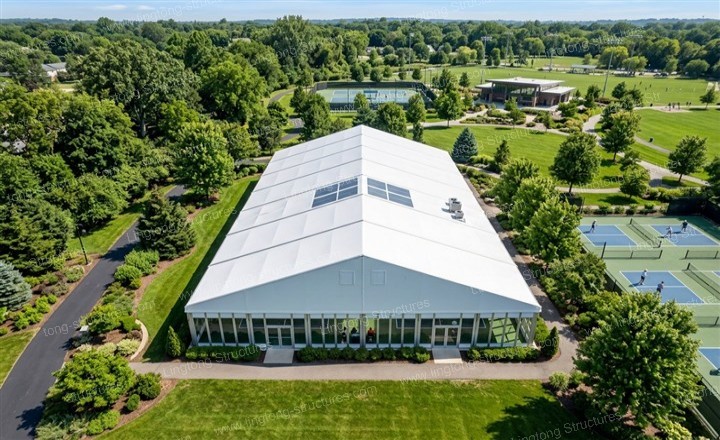
The pickleball hall offers a third option. It turns your venue into a movable asset. From an empty site to opening day takes about a month. And if the site becomes unavailable, you can take it apart and set it up somewhere else.
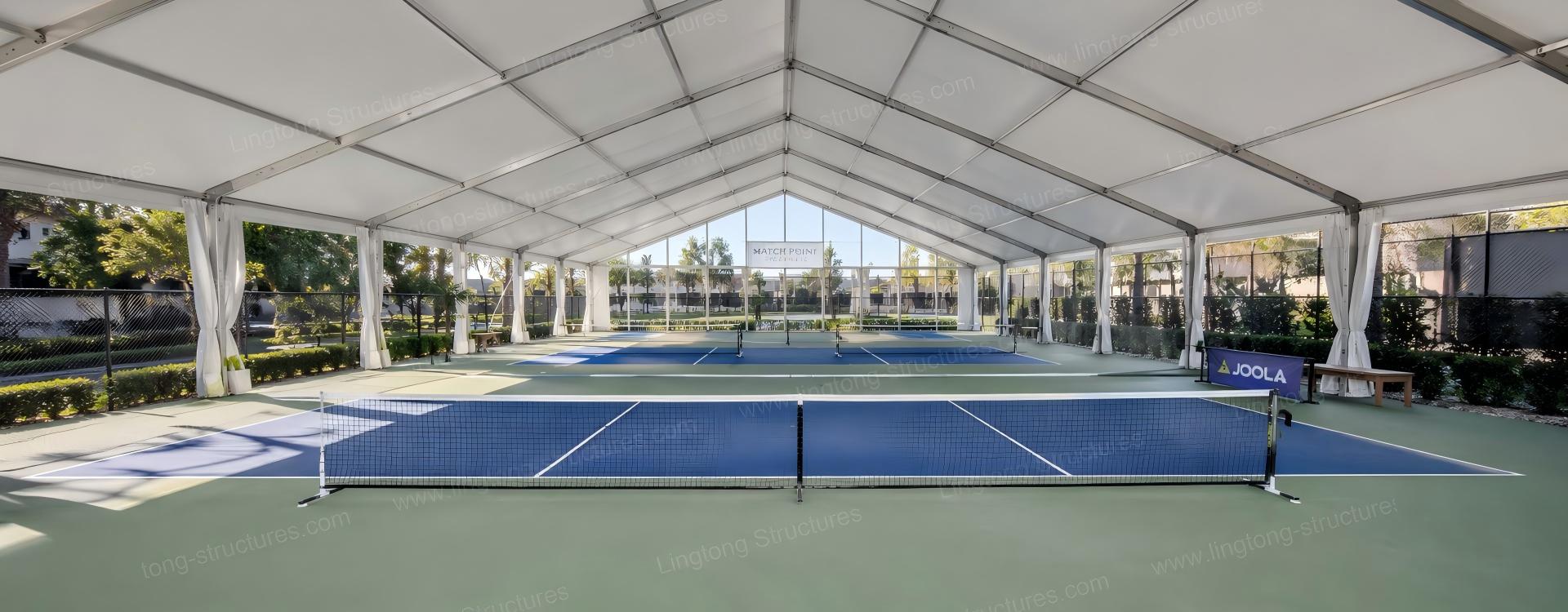
The frames and fabric covers of the pickleball hall are all prefabricated at the factory. On-site work is limited to bolting the components together. This isn't "building" a venue – it's "assembling" one. No foundation needed, no site construction, no damage to the existing ground. The entire facility is made of components, not built through construction steps. This is why it can go from zero to operational in a month, and also why it can be taken down and reassembled elsewhere.
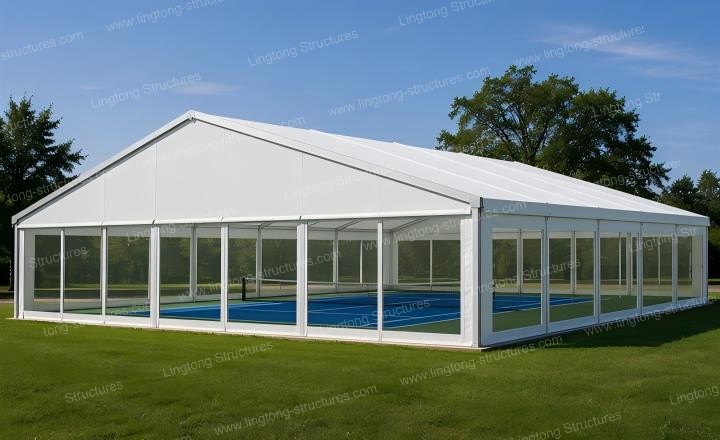
| Court Count | Layout | Dimensions | Area |
|---|---|---|---|
| 2 courts | Side by side | 15m × 20m | 300㎡ |
| 3 courts | Side by side | 22m × 20m | 440㎡ |
| 4 courts | 2 × 2 grid | 18m × 38m | 684㎡ |
| 6 courts | 3 × 2 grid | 22m × 38m | 836㎡ |
| 8 courts | 4 × 2 grid | 30m × 38m | 1140㎡ |
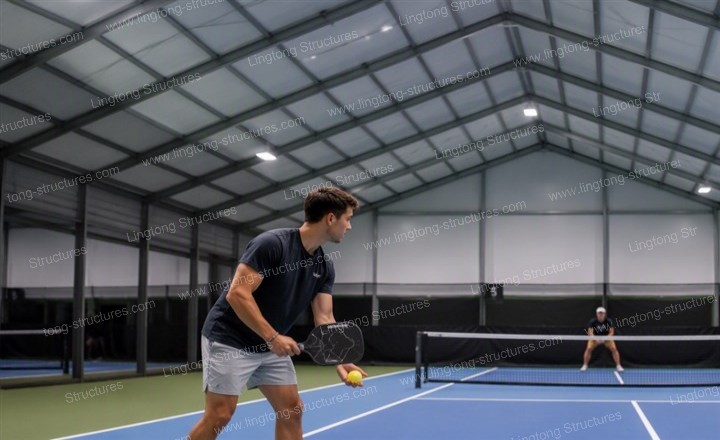
Spans are customizable, length extends in modules. Eave height adjustable from 5 to 13 meters – 5 meters minimum is sufficient for pickleball clearance requirements.
Many tent manufacturers can provide a shelter from rain and sun. Lingtong Tent builds venue-grade spaces.
The fabric is 850g – not the 650g or 750g commonly found elsewhere. This thickness difference directly affects tear resistance and service life. The frame uses 6082-T6 or 6061-T6 aluminum alloy with anodized surface treatment – no rusting even in coastal areas. All components are prefabricated at the factory and bolted together on-site – no welding.
These differences may not be noticeable in the short term, but they show up after five or more years of use. The aluminum frame stays rust-free and corrosion-free for 15-20 years. The fabric cover is replaced every 5-8 years with normal use, while the frame stays in place.
Pickleball halls are more versatile than traditional courts. Lay sports flooring and it's a professional pickleball facility. Use modular flooring and it can accommodate badminton, basketball, or volleyball. Clear the space and it can host community events, team-building activities, training sessions, exhibitions, or product launches. The same space, different uses at different times.
For venue operators, this means the facility doesn't rely on a single income stream. Weekdays for training and youth programs, weekends for tournaments and open play. During off-peak seasons, rent it out for other events. This shortens the investment payback period and spreads operational risk more broadly.
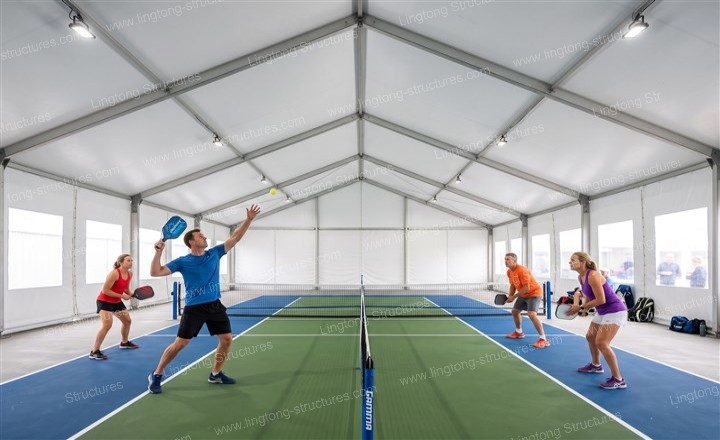
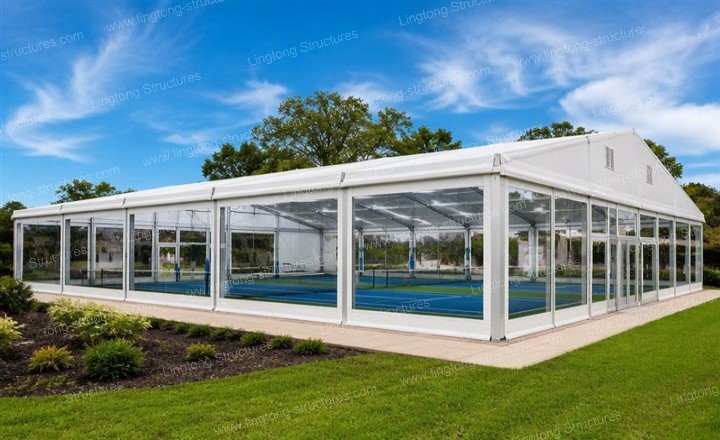
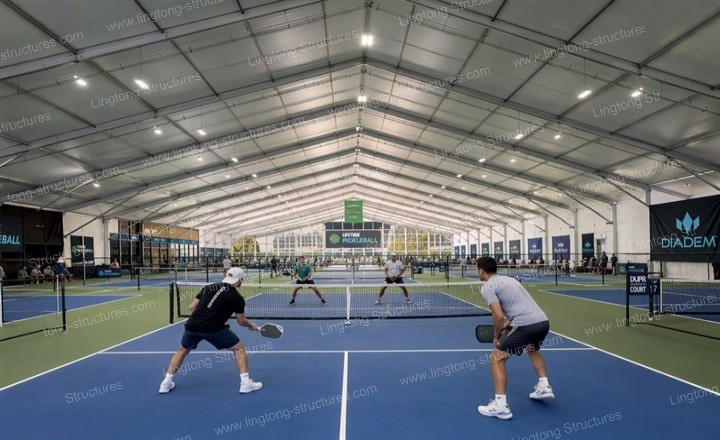
Flooring and lighting are core to the venue experience. Different configurations position the venue at different price points.
Basic Configuration (community courts, low-cost fast start): Acrylic coating on outdoor concrete – slip-resistant and durable. Netting or transparent PVC side walls. Anti-glare LED lighting at around 400 lux. Covers basic playing needs with the lowest investment and fastest deployment.
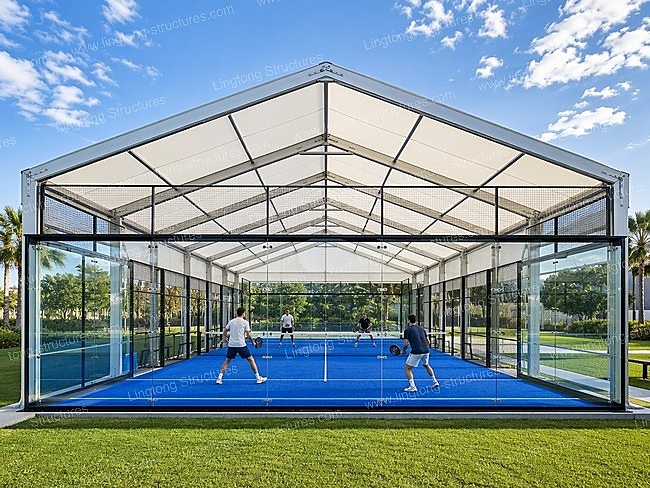
Standard Configuration (commercial venues, club operations): Sports vinyl or modular sports flooring indoors for professional feel. Transparent PVC side walls or glass curtain walls for natural daylight. Anti-glare LED lighting at 500-750 lux for amateur tournament hosting. This is currently the mainstream choice, balancing investment and experience.
Premium Configuration (tournament venues, brand centers): Modular sports flooring (removable and reusable) + full glass curtain walls (transparent, high-end feel) + anti-glare LED tournament lighting at 750+ lux + central air conditioning + fully enclosed side walls + custom-branded fabric cover. Designed for official tournaments and the highest price point.
Investment in a permanent venue is a one-time expense. When the site is no longer available, the investment goes to zero. Investment in a pickleball hall is recoverable. The aluminum frame and fabric can be sold second-hand after dismantling – the frame itself has residual value.
A frame designed for 15-20 years of use, sold after 5 years, still holds significant residual value. If relocating instead of selling, the dismantling and reinstallation process results in almost no material loss – only labor and transport costs are involved. This applies to clubs whose site leases are ending, operators who follow tournaments, and investors uncertain about long-term commitment.
| Item | Specification |
|---|---|
| Frame Material | 6082-T6/6061-T6 aluminum alloy, anodized |
| Cover Material | 850g/㎡ double-sided PVC coated fabric, B1 flame-retardant |
| Span Range | 10-80 meters (customizable) |
| Eave Height | 5-13 meters (customizable) |
| Length | Extendable in 3m or 5m modules |
| Wind Load | Up to 120km/h |
| Snow Load | Up to 1.5kN/m² |
| Frame Service Life | 15-20 years |
Flooring: Acrylic coating, sports vinyl, modular sports flooring
Walls: Transparent PVC side walls, tempered glass curtain walls, ABS hard walls, netting
Lighting: Anti-glare LED lights
Climate: Exhaust fans, air conditioning
Doors: Electric roller doors, sliding doors
Lingtong Tent has been manufacturing aluminum tents for 29 years. Our factory is located in Changzhou, Jiangsu, covering 20,000㎡. All processes are completed in-house – from aluminum extrusion and surface anodizing to fabric cutting and high-frequency welding – no white-labeling. Products are exported to over 200 countries with ISO9001 and CE certifications. We have provided tent structures for international events including the China Open and the Hangzhou Asian Games. We provide one-stop services from site survey, CAD design, 3D renderings, manufacturing to installation guidance, with free drawings and spare parts available at cost for life.
Q: Do I need a permit to install a pickleball hall?
A: Prefabricated structures are generally classified as temporary buildings, and most areas do not require planning permits. Local regulations vary – we recommend checking with your local planning department, and we can provide reference cases.
Q: How long does dismantling and reassembly take?
A: Dismantling takes 2-3 days. Reassembly also takes 2-3 days. The entire structure uses bolted connections – no cutting or welding required – so components can be reused after dismantling.
Q: Can the venue look as good as a permanent building?
A: Yes. Side walls can be upgraded to glass curtain walls or ABS hard walls. Fabric colors can be customized, and branding can be printed on the cover. The overall appearance can be close to that of a permanent building.
Q: Can the cover be replaced if it gets damaged?
A: Yes. The cover is independently fixed to the frame, so if it's damaged or worn out, you only need to replace the cover – the frame stays in place.
Q: How long does the hall last?
A: The aluminum frame lasts 15-20 years. The cover is replaced every 5-8 years depending on local climate and frequency of use. Both the frame and cover can be replaced separately.




 Inquire Now