


 sales1@lingtong-structures.com









Product Categories
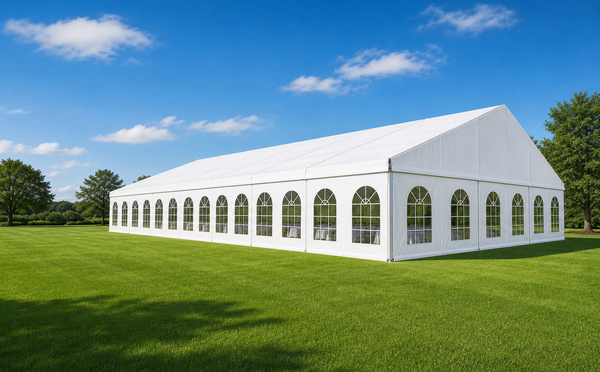
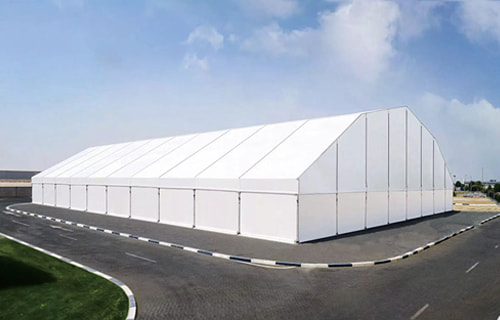
Warehouse Tent
Warehouse Tent
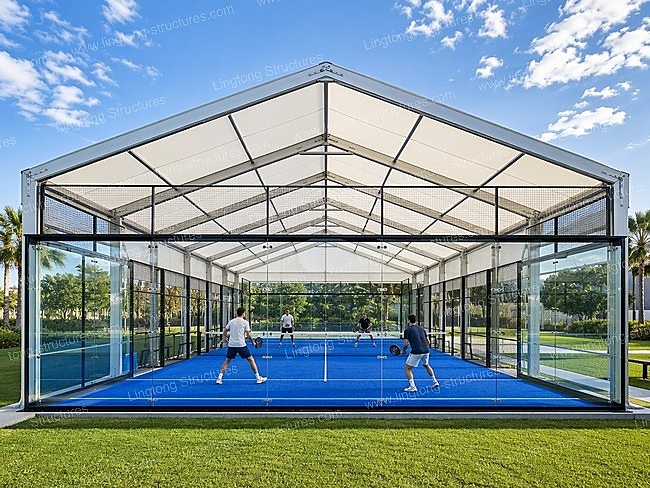
Sports Court Tent
Sports Court Tent
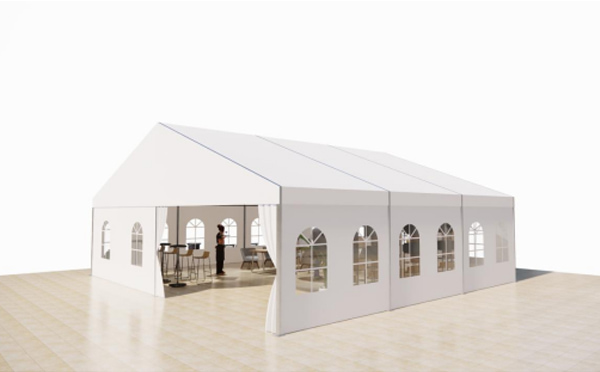
Commercial Event Tent

Commercial Event Tent



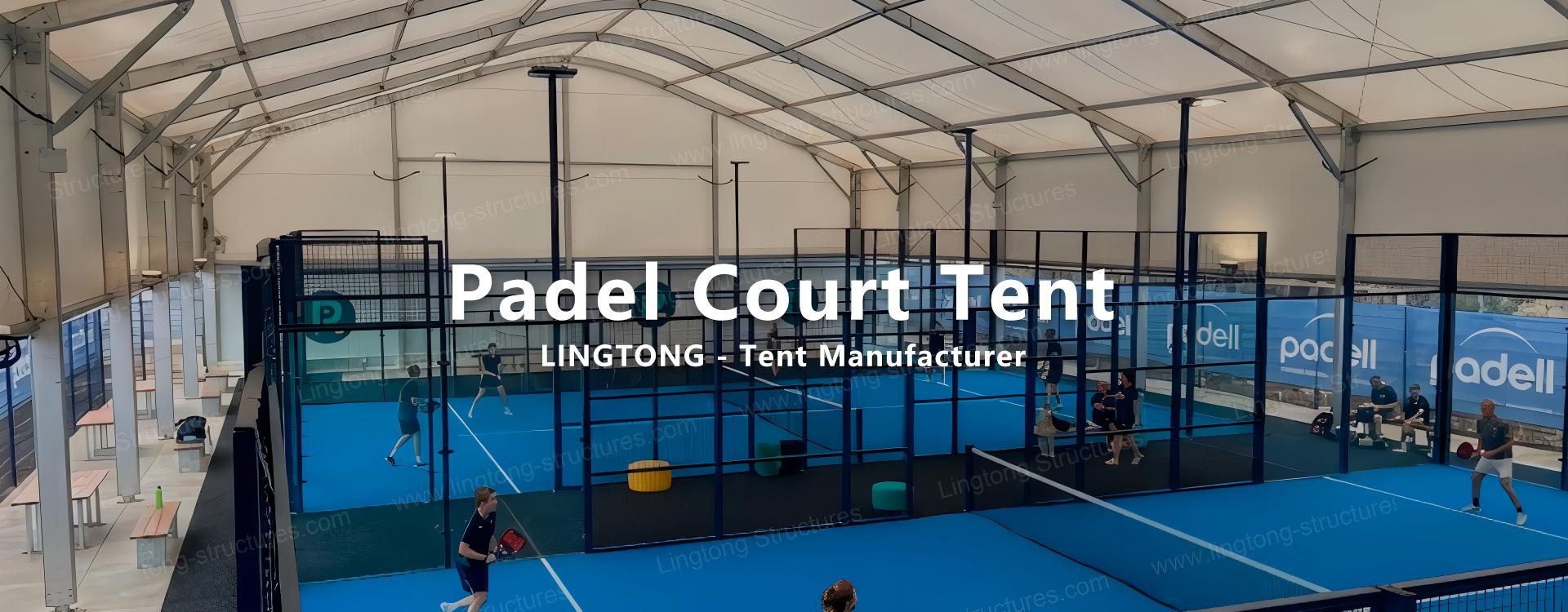 Padel is growing rapidly worldwide and has been included as an official sport in the 2030 Dakar Asian Games. In China, Padel courts have grown from just over 100 to approximately 2,000, with multiple chain clubs opening in core business districts of first-tier cities. Market demand is strong, but traditional fixed venue construction takes too long and costs too much to keep up with the industry's expansion pace.
Padel court tents offer an efficient turnkey solution – no concrete foundation required, significantly reducing permitting complexity, no damage to existing ground. With drawings confirmed and site conditions ready, the entire project can be operational within approximately 30 days.
A standard Padel court measures 20 meters long and 10 meters wide, with a single court area of approximately 200㎡ – less than one-third of a traditional tennis court. A minimum 2-meter buffer zone must be reserved outside the court lines for glass panels and metal fencing. A key feature of Padel is that the ball can rebound off the glass panels and remain in play.
The tent provides all-weather overhead cover, converting outdoor courts into a space protected from rain, snow, and sun exposure. It's important to note: the glass panels and metal fencing are part of the court itself, not included with the tent structure.
Padel court tents differ fundamentally from pickleball and basketball tents – a complete Padel venue consists of three parts: the court, glass fencing, and the tent roof. The tent provides the roof and side wall enclosure, while the sports flooring and glass fencing are installed separately by specialized sports construction contractors.
| Court Count | Tent Size (W × L) | Total Area | Application |
|---|---|---|---|
| 2 side by side | 22m × 25m | 550㎡ | Community club, small training center |
| 3 side by side | 32m × 25m | 800㎡ | Mid-size club, commercial operation |
| 4 (2×2 grid) | 25m × 45m | 1125㎡ | Large club, tournament venue |
| 6 (3×2 grid) | 32m × 45m | 1440㎡ | Professional training base, regional center |
Tent spans can be adjusted based on site conditions, with length extendable in 3m or 5m modules. The minimum clearance requirement for Padel tournaments is 6 meters – we recommend an eave height of 6 meters or above for actual projects.
Padel court tents follow the opposite logic of traditional fixed venues. Traditional venues build the structure first, then lay out the courts inside. A Padel tent, by contrast, starts with the complete Padel court (including glass fencing) as the core – the tent simply serves as the roof cover. The tent is built around the pre-planned court layout, with court dimensions taking priority. No need to accommodate structural columns – span, eave height, and length are all customizable to fit the court configuration.
The tempered glass panels and metal fencing around the court are independent systems not supplied with the tent. All tent columns are positioned outside the fence buffer zone, with the two structures operating independently and not encroaching on the court's playing area.
Glass panels are typically 4 meters high, made of laminated tempered glass that meets International Padel Federation (FIP) standards, paired with same-height metal fencing with mesh sizes designed to prevent ball trapping.
Padel courts can use concrete-free suspended flooring systems installed directly on existing level surfaces – asphalt, concrete hardstand, rooftop decks, or compacted bases are all suitable. This solution installs quickly, offers controllable costs, and can be relocated as a whole – particularly suitable for leased sites or rooftop conversion projects.
Flooring installation takes 3-5 days and can proceed simultaneously with tent production. With drawings confirmed and site conditions ready, the overall project timeline from site preparation to operational handover is approximately 30 days.
Important note: While the tent itself does not require a concrete foundation, it must be secured with ground anchors or ballast weights. Anchoring performance on compacted soil is limited – additional reinforcement is required for windy regions.
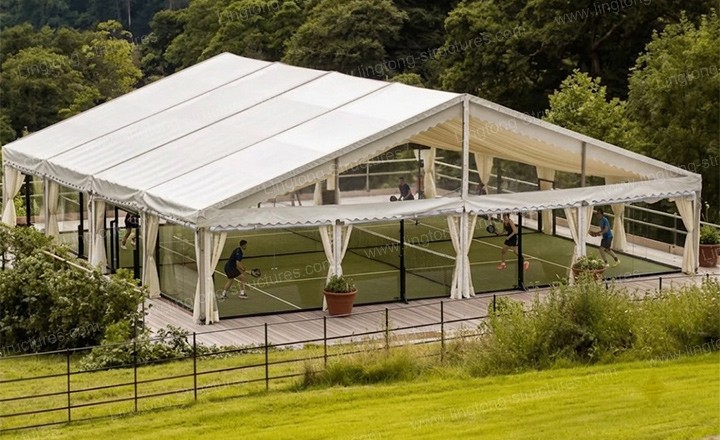
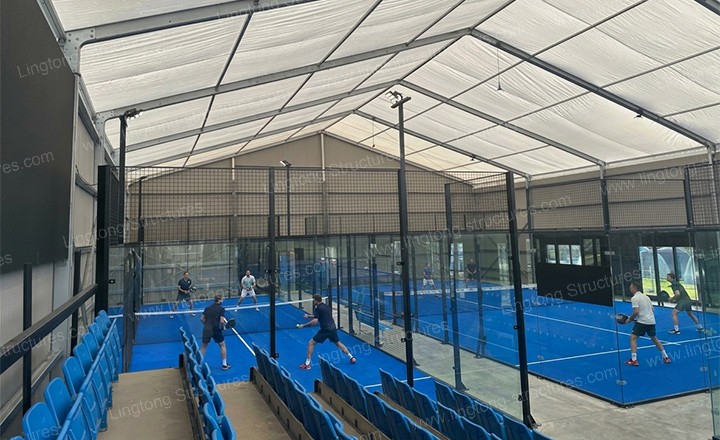
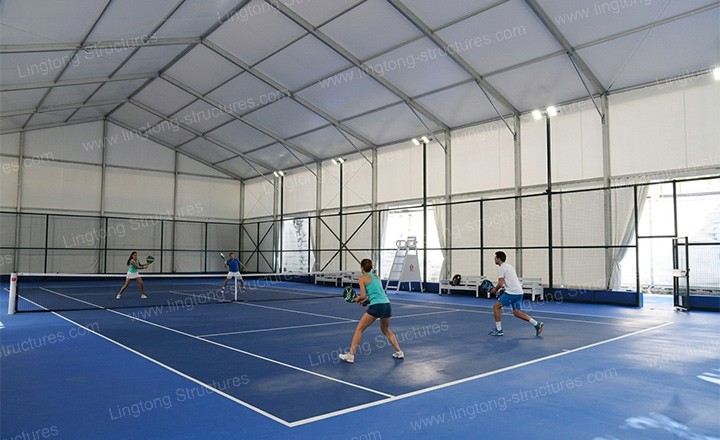
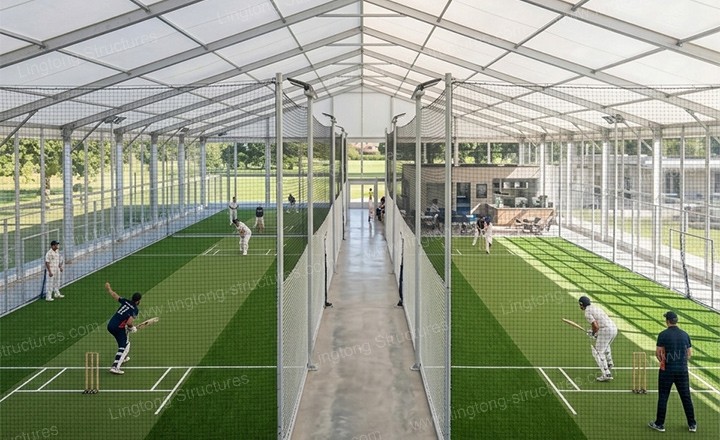
Side Walls: Transparent PVC side walls (natural lighting), glass curtain walls, netting (semi-open concept)
Lighting: Anti-glare LED tournament lights, 750+ lux illumination for official competition standards
Ventilation: Exhaust fans, natural ventilation windows, air conditioning units
Doors: Electric roller doors, sliding doors
Others: Mobile bleacher seating, referee area, indoor lounge zone
| Item | Specification |
|---|---|
| Frame Material | 6082-T6/6061-T6 aluminum alloy, anodized |
| Cover Material | 850g/㎡ double-sided PVC coated fabric, B1 flame-retardant, waterproof, UV-resistant |
| Span Range | 10-80 meters (customizable) |
| Eave Height | 6-13 meters (customizable) |
| Length | Extendable in 3m or 5m modules |
| Wind Load | Up to 120km/h |
| Snow Load | Up to 1.5kN/m² |
| Frame Service Life | 15-20 years |
| Cover Service Life | 8-12 years (varies by environment and maintenance) |
Lingtong Tent has 29 years of experience in aluminum tent manufacturing, with its factory located in Changzhou, Jiangsu, covering 20,000㎡. All production processes – aluminum extrusion, surface anodizing, and PVC fabric high-frequency welding – are completed in-house. Products are exported to over 200 countries with ISO9001 and CE certifications, and we have provided tent structures for major tennis events and comprehensive sports events in China.
For Padel court tents, we provide a full-service package including site survey, CAD drawings, 3D renderings, manufacturing, and installation guidance, with spare parts available at cost for ongoing support.
Q: How long does it take to install a Padel court tent?
A: Tent installation takes 3-7 days on-site. Suspended flooring installation takes 3-5 days. These two phases can proceed simultaneously. With drawings confirmed and site conditions ready, the overall project timeline is approximately 30 days.
Q: How does the tent connect with the fencing and glass?
A: The tent and fencing are two independent systems. The tent provides the roof and side wall enclosure. The glass and fencing are installed by specialized sports construction contractors. Tent columns are positioned outside the fence perimeter, with no interference between the two structures.
Q: What is the structural difference between a Padel court tent and a standard sports tent?
A: Padel court tents require larger spans and higher eave heights than standard sports tents – minimum 6-meter clearance and spans up to 80 meters – while also accommodating space for the surrounding glass fencing. The overall structural load is greater, accounting for roof cover weight, lateral wind pressure, and additional loads from the court fencing.
Q: Does a Padel court tent require a foundation?
A: The tent itself does not require a concrete foundation – it can be installed on concrete, asphalt, or compacted soil, but must be secured with ballast weights or ground anchors. The court flooring can use a concrete-free suspended system installed directly on the existing level surface.
Q: Can you support installation for overseas projects?
A: Yes. We provide complete installation drawings and video tutorials. For large overseas projects, we can arrange engineers to travel on-site for installation guidance.
If you're planning a Padel club project, send us your site dimensions and local climate conditions – we'll provide a customized proposal.




 Inquire Now