


 sales1@lingtong-structures.com











Padel Tennis Boom: Why Many Investors Get the Math Wrong
 Aug 06, 2026|
 View:141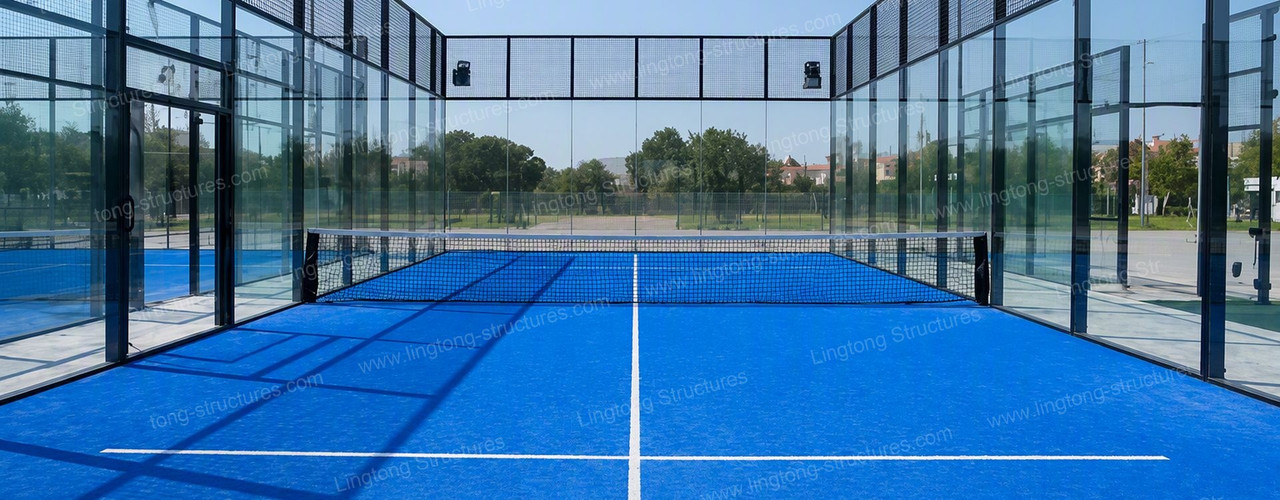
Padel tennis is heating up fast across Europe, and the numbers tell the story.
The global padel market was valued at $281 million in 2025 and is projected to reach $459 million by 2032, with Europe accounting for nearly half of global revenue. Worldwide players have exceeded 35 million, with 77,300 courts in total—up 15.2% year-over-year. In 2025 alone, 8,000 new courts were added.
But rising market heat doesn't guarantee profits. Many clubs and investors who jumped in got their math wrong from the start, only discovering hidden losses after operations began.
Three Regional Markets, Three Completely Different Business Logics
Spain is the birthplace of padel and the most mature market. The country has 4,500 clubs, 17,000 courts, and 6.72 million players—12.7% of the population. Court infrastructure is largely saturated, and building new courts alone no longer generates returns. Growth now comes from operational value-add: private coaching, sports tourism experiences, and commercial tournaments.
Italy surpassed 10,000 courts in 2025 with 1.5 million players. The market is still expanding, but the growth rate has slowed noticeably.
The most interesting story is the UK.
The UK broke 1,000 courts in 2025. Lawn Tennis Association data shows that 860,000 Brits played padel at least once in 2025, up from 400,000 in 2024 and just 129,000 in 2023. That's a sixfold increase in three years. Clubs have grown from around 130 to nearly 300.
I spoke with a club operator in southeast England. He opened in 2022 with two outdoor courts and fewer than 200 members. He added a roof in 2024 and two more courts in 2025. Weekday evenings are fully booked; Saturday mornings start queuing at 8 a.m.
"On the surface, business looks booming, but real revenue isn't what the spreadsheets say," he told me.
In the summer of 2023, the club received three noise complaints from nearby residents. The courts sit next to a residential area, and the sound of evening play disturbed the neighbors. They ended up cutting evening hours by 90 minutes—directly reducing revenue. If they had planned for noise buffers during the site selection phase, that loss could have been avoided entirely.
Germany operates on a different model.
A large portion of Germany's new padel courts come from converted tennis courts. Traditional tennis courts take up more space, cost more to maintain, and are losing participants. Converting them to padel allows more courts on the same land and attracts more foot traffic. Germany's strict permitting process also filters out impulsive projects, resulting in higher overall quality among surviving facilities compared to the UK.
How to Actually Calculate the Padel Investment
Let's start with traditional court construction costs as a baseline.
Costs vary significantly by region. In the UK, an outdoor court with lighting runs around £75,000; with a roof, about £130,000. US market costs are lower, ranging from $20,000 to $65,000 per court. A 4-to-6 court outdoor club—including courts, land, infrastructure, and a basic clubhouse—typically requires $500,000 to $1.5 million in total investment.
On the revenue side, a single padel court generates between €2,000 and €10,000 per month. Industry payback periods vary widely—some claim under two years, but most projects fall in the 3-to-7 year range. The outcome depends heavily on location, operational capability, and court utilization.
Many investors overlook a key feature of padel: it's primarily a doubles sport, with four players per court. During peak hours, the same court generates more revenue, along with more lesson demand and ancillary spending. In the US market, a 90-minute session costs $20-50 per person—$120-160 total for a four-player game.
Padel and pickleball are not the same thing. Pickleball wins on low barriers to entry and mass participation. Padel commands higher average spend per customer—not just on court fees, but also on rackets, shoes, accessories, and on-site food and beverage.
Aluminum vs. Traditional Construction: A Cost Comparison
Looking at traditional and aluminum courts side by side, the differences are clear.
Upfront investment: Traditional construction in the UK runs about £130,000 for a single roofed court, with 4-6 court clubs totaling $500,000 to $1.5 million. Aluminum structures can be priced separately, but the key difference is that they don't require large-scale concrete foundations—eliminating that cost entirely.
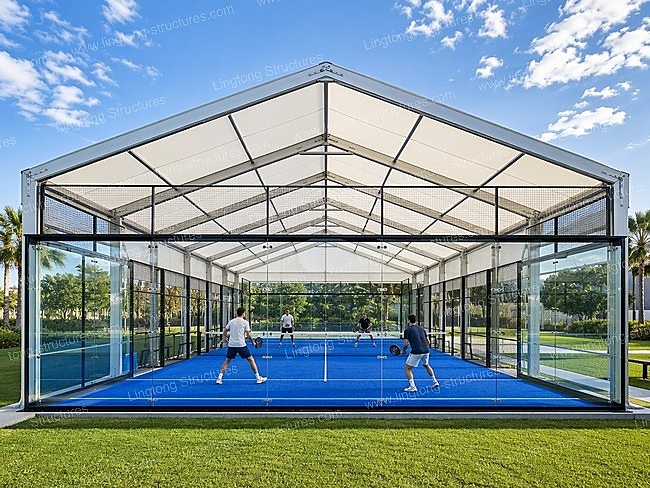
Foundation and site: Traditional construction requires excavation, concrete pouring, and curing time—costs that make up a significant portion of the total budget. Aluminum structures can be installed directly on the ground without disturbing the existing surface. In locations where traditional construction is either too expensive or simply impossible—city rooftops, beaches, hillsides, parking lots—aluminum solutions can actually work.
Permitting and construction: Traditional construction involves planning permission, building permits, and site work, typically measured in years. Aluminum structures are classified as temporary buildings in some regions, with simplified permitting and construction timelines measured in weeks.
Flexibility and asset value: Traditional construction is permanent—you can't move it, and demolition costs money. Aluminum structures are demountable, relocatable, and reusable, with over 95% of materials recoverable.
Lifespan and maintenance: Traditional concrete structures have long lifespans, but roofs and equipment still require regular maintenance. Aluminum frames last 20+ years, with wind resistance of 100-120 km/h, snow load capacity of 75 kg/m², and corrosion resistance in coastal areas—no regular painting required like steel.
Aluminum solutions won't replace traditional construction. They address a different set of needs: leased land, uncertain lease terms, the need to open quickly, and the possibility of having to move later. Traditional construction suits owned land and long-term commitments. The choice depends on your land situation and capital plan.
Common Pitfalls in Real Projects
Don't overcompress court layout. Padel players frequently hit the walls and fences—you need adequate safety clearance around each court. Some investors try to squeeze in extra courts by minimizing spacing, only to find players getting injured and quitting after one season.
Permitting rules vary widely. Some regions classify aluminum modular courts as temporary structures with fast approvals. Others require full structural safety reviews. In UK Green Belt or conservation areas, the approval process can drag on significantly—check the rules beforehand.
Don't cut corners on drainage. Modular courts have minimal foundation requirements, so drainage relies entirely on site grading and French drains. One project skipped proper drainage design—water pooled on the court for two days after rain, and they had to redo the work.
Daytime vacancy is a hidden cost. Most courts see low utilization between noon and late afternoon, but land rent is charged for the full day. Empty daytime slots still burn cash.
There are ways to mitigate this. Here's how some clubs fill weekday daytime hours:
Senior sessions. Morning weekdays for senior padel. Moderate intensity, strong social appeal—the 55-70 demographic has time, spending power, and high loyalty.
Corporate team building. Tuesday to Thursday afternoons are prime for corporate events. Padel is easy to pick up, moderately competitive, and works well for group tournaments—one of the highest-rated team activities. Charge a premium for court rentals, often double the standard rate.
School youth programs. 3-5 p.m. sessions for nearby schools' PE classes or after-school training. Long-term, stable partnerships with lower per-session revenue but high volume, consistency, and zero marketing cost.
Discount off-peak hours. Weekdays 12-3 p.m., offer half-price or package deals for idle courts. No platforms needed—just push through community groups. Lower margins, but better than sitting empty.
Fill these slots and you can realistically push weekday daytime court utilization from under 20% to over 50%. Over a year, that's a significant difference in vacancy cost.
A Few Practical Takeaways
Padel's growth wave is still going, but European markets are at very different stages: Spain and Italy are in consolidation mode; the UK and Germany are in rapid expansion; the US is still early. You can't copy-paste the same approach across markets.
Aluminum modular courts work for leased-land operations, those looking to minimize sunk costs, those needing to open quickly, and those who may need to relocate later. If you own your land and are in it for the long haul, traditional construction may offer better long-term value.
To enter the padel market wisely, focus on three key pieces of research: how long you can stay on the land, how long local permitting actually takes, and whether you can sell daytime slots. Many projects fail because they didn't match their construction approach to their site conditions, local regulations, and operating reality.
If you're evaluating a project, start by getting those three numbers. And if you're unsure whether your site suits traditional or modular construction, bring your site details and budget—we can run a side-by-side comparison tailored to your situation.