


 sales1@lingtong-structures.com











 Apr 20, 2026
 View:388
In today's fast-paced business environment, the need for adaptable, efficient, and cost-effective infrastructure is greater than ever. When faced with expanding operations, seasonal demand spikes, or temporary project sites, the age-old question arises: should you invest in a permanent traditional building or opt for a modern industrial tent system? This decision impacts not just your immediate budget but also long-term operational agility and return on investment. This article provides a detailed, side-by-side comparison of industrial tent systems and traditional construction methods across all critical dimensions—from initial capital outlay and deployment speed to flexibility, durability, and total cost of ownership. By the end, you'll have a clear framework to determine which solution best aligns with your project's timeline, budget, and strategic goals.
Key Takeaways
Cost Efficiency: Industrial tent systems typically offer significantly lower upfront capital expenditure (CAPEX) and faster financial payback compared to traditional buildings, especially for needs under 3-5 years.
Deployment Speed: A key advantage of industrial tents is rapid deployment, with structures often operational in days or weeks, versus months or years for traditional construction.
Unmatched Flexibility: Industrial tents are modular, relocatable, and easily expandable, offering adaptability that fixed traditional structures cannot match.
Proven Durability: Modern industrial tents are engineered structures, not simple shelters. They are designed to withstand significant wind, snow, and environmental loads for over a decade.
Strategic Fit: The choice isn't about which is universally better, but which is right for your specific use case, duration, and operational requirements.
1. The Fundamental Difference: Permanence vs. Adaptability
The core distinction lies in design philosophy. Traditional building methods—using concrete, steel, and masonry—are designed for permanence. They are fixed assets intended for decades of use on a single site. Their value is derived from long-term stability, high levels of insulation, and integration with municipal utilities.
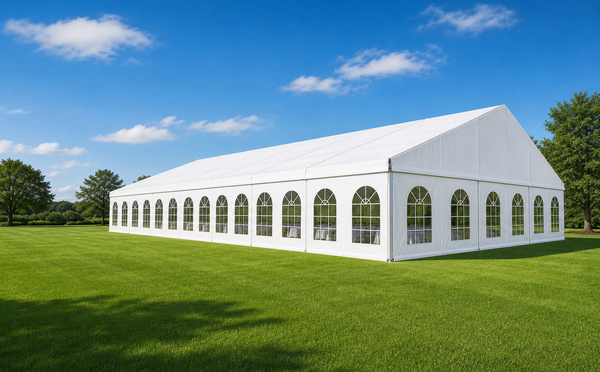
In contrast, an industrial tent system is engineered for adaptability. It is a semi-permanent or temporary clear-span structure, typically featuring a high-strength aluminum alloy frame and a durable PVC-coated polyester or vinyl membrane. Its value is derived from speed, flexibility, and reusability. Think of it as a high-performance, rapidly deployable asset rather than a fixed piece of real estate.
2. Head-to-Head Comparison: Breaking Down the Key Factors
A. Cost Analysis: Upfront CAPEX vs. Total Cost of Ownership (TCO)
| Factor | Industrial Tent System | Traditional Building | Verdict |
|---|---|---|---|
| Initial Investment (CAPEX) | Significantly lower. Costs cover the engineered structure, membrane, and installation. No extensive foundation or lengthy labor required. | Very high. Includes land (if not owned), architectural/engineering fees, materials (steel, concrete), skilled labor, permits, and utility hookups. | Industrial tents win on initial outlay. |
| Construction Time & Soft Costs | Minimal. Swift setup (e.g.,<4 hours for 500㎡) drastically reduces financing costs, project management overhead, and lost revenue due to downtime. | Substantial. Projects taking 6-18 months incur ongoing interest, management costs, and opportunity cost from delayed operations. | Industrial tents win on time-to-value. |
| Maintenance & Operating Costs | Generally low. Routine cleaning and inspection of fabric and frame. No property taxes in most jurisdictions for temporary structures. | Can be high. Includes roof repairs, HVAC servicing, property taxes, insurance, and ongoing utility costs for a large, permanent envelope. | Industrial tents often win, especially when property tax is considered. |
| Relocation & Residual Value | High. The entire industrial tent system can be disassembled, moved, and redeployed, retaining most of its value for the next project. | Negligible. A traditional building is a fixed asset. Its value is tied to the land; the structure itself cannot be moved. | Industrial tents win for dynamic or multi-phase projects. |
| Best Financial Fit | Projects with a 3-10 year horizon, uncertain future needs, or requiring rapid ROI. | Long-term (15+ years) operations on a permanent, stable site where the high initial cost can be amortized over decades. |
B. Timeline: From Concept to Operation
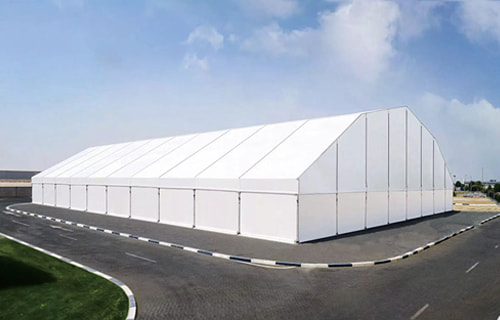
Industrial Tent System: The timeline is remarkably short. After design finalization and manufacturing, site preparation is minimal (often just leveling). Installation is measured in days or weeks. A standard 1,000㎡ warehouse tent can be operational within a week, allowing businesses to respond immediately to market opportunities or storage crises.
Traditional Building: The process is lengthy. It involves architectural design, engineering approvals, permitting (which can take months alone), site excavation, foundation pouring, structural erection, enclosure, and interior finishing. This process typically spans 6 to 24 months, delaying the start of revenue-generating activities.
C. Flexibility & Scalability
This is where industrial tent systems demonstrate a decisive advantage.
Relocatability: Need to move your storage facility to a new logistics hub? An industrial tent can be packed and relocated. A traditional building cannot.
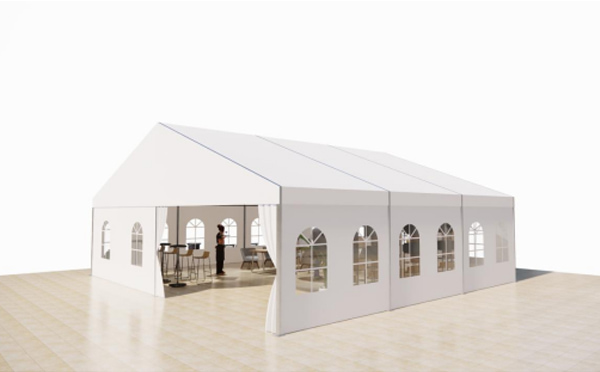
Expandability: Business is growing? Many industrial tent designs are modular. You can easily add more bays to increase floor space. Expanding a traditional warehouse requires a new construction project.
Temporary Use: Perfect for construction site offices, seasonal inventory storage, event coverage, or as a bridging solution during permanent facility renovations.
D. Durability & Performance
A common misconception is that tents are fragile. Modern industrial tents are engineered structures.
Weather Resistance: High-quality systems, like those from experienced manufacturers, are designed to withstand wind loads of 120 km/h or more and substantial snow accumulation. The engineered aluminum frame and tensioned membrane form a robust structure.
Fire Safety: Membranes can be certified to international standards like DIN4102-B1 for flame retardancy, and the overall structure can comply with standards like EN 13782 for temporary structures.
Lifespan: With proper maintenance, a premium industrial tent system can have a service life exceeding 15 years. While shorter than a steel building's 50+ years, it aligns perfectly with medium-term strategic needs.
E. Environmental & Sustainability Considerations
Industrial Tent Systems: Have a lower embodied carbon footprint for medium-term use. The aluminum frame is 100% recyclable, and the modular nature reduces construction waste. Their reusability across multiple projects further enhances sustainability.
Traditional Buildings: While durable, the production of concrete and steel is carbon-intensive. They generate significant construction waste and are not demountable.
3. Making the Right Choice: A Decision Framework
Use this guide to align your needs with the right solution:
| Your Requirement | Recommended Solution | Primary Reason |
|---|---|---|
| Need space in < 3 months | Industrial Tent System | Unbeatable deployment speed. |
| Budget is tight upfront | Industrial Tent System | Lower initial CAPEX improves cash flow. |
| Future site or space needs are uncertain | Industrial Tent System | Relocatable and scalable. |
| Operation is permanent (>15 years) | Traditional Building | Long-term cost amortization favors permanence. |
| Heavy, vibration-intensive machinery | Traditional Building | Requires massive, fixed foundations. |
| Critical, climate-sensitive storage (e.g., pharmaceuticals) | Traditional Building | Superior and more stable insulation/air sealing. |
| A temporary site office or 3-5 year project warehouse | Industrial Tent System | Optimal balance of cost, speed, and performance. |
4. Why Choose Lingtong for Your Industrial Tent Solution?
For over three decades, Lingtong has been at the forefront of engineering high-performance, adaptable shelter solutions. We understand that choosing an industrial tent system is a significant operational decision. Our approach is built on the EEAT principles (Experience, Expertise, Authoritativeness, Trustworthiness):
Experience & Expertise: Our team provides end-to-end support, from customized tent design that meets your exact spatial and load requirements to full tent installation service. We engineer our structures, like the one detailed on our Industrial Tent page, to perform reliably in difficult conditions.
Authoritativeness: Our solutions are backed by international certifications, including ISO 9001 for quality management and product compliance with EN 13782 for temporary structures. Our high-strength aluminum alloy frames are proof-engineered for safety.
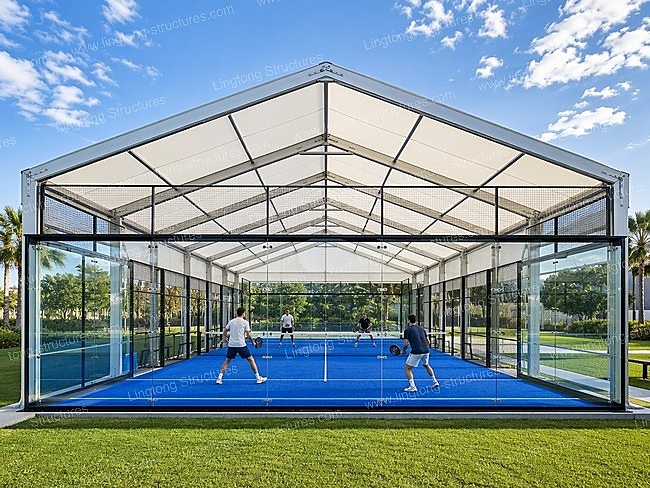
Trustworthiness: We don't just sell a product; we provide a solution. This includes guidance on temporary building permits & approvals and the provision of all necessary accessory amenities like lighting, ventilation, and flooring. Our project portfolio, spanning warehouse storage, sports facilities, and event venues, demonstrates our reliable execution.
An industrial tent system from Lingtong is more than a purchase; it's a strategic partnership for agile infrastructure.
FAQ: Industrial Tents vs. Traditional Buildings
Conclusion
The debate between industrial tent systems and traditional building methods isn't about finding a superior option, but the appropriate one. For businesses prioritizing speed, financial flexibility, and operational agility, the modern industrial tent presents a compelling, high-performance alternative. It transforms capital expenditure into a flexible, scalable asset. For permanent, decades-long installations with no future movement anticipated, traditional construction remains the standard. By carefully weighing the factors of cost, time, flexibility, and durability outlined here, you can make a confident, strategic decision that supports your business objectives for years to come.