


 sales1@lingtong-structures.com








Cost vs. Speed: The 2026 Data on Temporary vs. Permanent Warehouses
 Mar 21, 2026|
 View:461
Introduction
As we approach 2026, logistics directors and manufacturing plant owners face a critical expansion decision: invest in traditional permanent warehouses or opt for modern temporary warehouse solutions. With supply chain volatility and the need for rapid scalability, this choice directly impacts cash flow, operational flexibility, and long-term profitability. This comprehensive analysis examines the core differences between temporary aluminum clear-span tents and permanent concrete-steel structures across three crucial dimensions: approval cycles, construction costs, and tax implications (movable vs. immovable property). For businesses prioritizing rapid capital recovery and operational agility in 2026's competitive landscape, understanding these distinctions is essential for making informed financial decisions.
Key Takeaways
Approval Speed: Temporary warehouse solutions can be operational in 30-60 days with minimal permitting, while permanent buildings typically require 6-18 months for full approval and construction.
Initial Investment: The upfront cost for a temporary warehouse is significantly lower, often 60-80% less than a comparable permanent structure.
Tax Advantage: Temporary warehouses are classified as movable assets (equipment), potentially qualifying for accelerated depreciation and different tax treatment compared to permanent real estate.
ROI Timeline: Businesses can achieve positive cash flow and full ROI with temporary solutions within 1-3 years, compared to 5-10+ years for permanent buildings.
2026 Trend: The shift toward flexible, sustainable, and cost-effective temporary infrastructure is accelerating, driven by economic uncertainty and the need for agile supply chains.
Detailed Comparative Analysis
1. Approval and Construction Timeline: Speed to Market
The most immediate difference between a temporary warehouse and a permanent building is the time from decision to operation.
Permanent Building (Traditional Steel-Concrete Warehouse): The journey for a permanent structure is lengthy and complex. It begins with architectural design and engineering, followed by a protracted permitting process involving zoning, environmental impact assessments, and building code compliance with local authorities. This phase alone can consume 3-9 months. Construction itself is weather-dependent and sequential, involving foundation pouring, steel erection, cladding, and interior work, typically taking another 6-12 months. In total, a company may wait 9-18 months before the first pallet is stored.
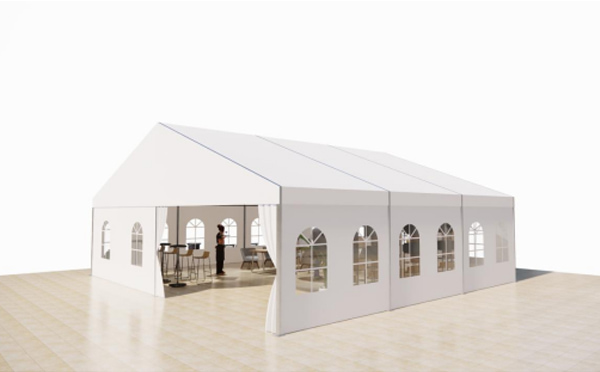
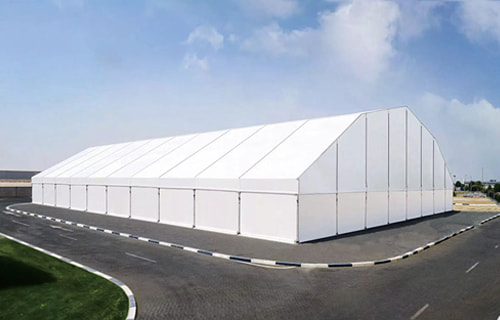
Temporary Warehouse (Aluminum Clear-Span Tent): In stark contrast, modern temporary warehouse solutions like those from Lingtong Structures offer a dramatically accelerated path. As modular, prefabricated structures, they often fall under different, simplified permitting categories as temporary installations. The approval process can be as short as 2-4 weeks. On-site, the modular aluminum frame and tensioned fabric membrane can be assembled by specialized teams in 1-3 weeks. From order to operation, a fully functional, large-scale storage facility can be ready in 30-60 days. This speed allows businesses to capitalize on immediate market opportunities or manage seasonal spikes without long-term commitment.
| Phase | Permanent Building | Temporary Warehouse |
|---|---|---|
| Design & Planning | 2-4 months | 1-2 weeks (standard designs) |
| Permits & Approvals | 3-9 months | 2-4 weeks |
| Foundation Work | 1-2 months | Days (minimal site prep) |
| Structure Construction | 6-10 months | 1-3 weeks |
| Total Estimated Time | 9-18 months | 30-60 days |
2. Capital Expenditure and Cost Structure
The financial outlay for these two options differs not just in magnitude but in nature.
Permanent Building: High Fixed, Sunk Cost
Constructing a permanent warehouse is a major capital project. Costs include land acquisition (if not owned), architectural fees, permitting fees, extensive groundworks and deep foundations, materials (steel, concrete, cladding), labor, and utility hookups. According to industry benchmarks, costs can range from $150 to $300+ per square foot, making a medium-sized warehouse a multi-million dollar investment. This capital is largely sunk into fixed real estate.
Temporary Warehouse: Lower, Flexible Investment
A temporary warehouse presents a fundamentally different cost model. The primary expense is the prefabricated structure itself—high-strength aluminum alloy frames and durable PVC membrane. Site preparation is minimal, often requiring only level ground. This results in a cost range of approximately $20 to $50 per square foot. Furthermore, businesses can choose to lease a temporary structure, transforming a large capital expenditure (CapEx) into a manageable operational expense (OpEx). This preserves capital for core business activities. For a temporary warehouse vs permanent building cost analysis, the former offers immediate savings of 60-80%.
3. Tax and Accounting Treatment: Movable vs. Immovable Assets
This is a crucial financial differentiator often overlooked in the temporary warehouse vs permanent building debate.
Permanent Building: Real Estate (Immovable Property)
A traditional warehouse is classified as real property. It is subject to property taxes, requires depreciation over a long period (typically 27.5 or 39 years under systems like MACRS in the US), and its sale triggers capital gains tax. Financing usually involves mortgages, impacting the company's debt profile.
Temporary Warehouse: Equipment (Movable Asset)
A key advantage of a temporary warehouse is its classification as movable equipment or tangible personal property. This can lead to significant benefits:
Accelerated Depreciation: It may qualify for faster write-off schedules (e.g., 5-7 years), reducing taxable income more quickly.
Different Tax Rates: Equipment may be subject to different, often lower, personal property tax rates compared to real estate taxes.
Investment Incentives: It may be eligible for immediate expensing provisions or bonus depreciation offered by governments to stimulate business investment.
Balance Sheet Flexibility: As an asset that can be relocated or sold, it doesn't tie the business to a specific geographic location.
4. Return on Investment (ROI) and Payback Period
The ultimate question for a financial decision-maker is: "Which option gets my money back faster?"
Permanent Building: Long-Term ROI
The ROI for a permanent building is calculated over decades. The payback period relies on long-term occupancy, stable property value appreciation, and the avoided cost of long-term leasing. Positive cash flow may take 5 to 10 years or more to achieve, locking capital for an extended period.
Temporary Warehouse: Rapid ROI and Agile Cash Flow
The temporary warehouse shines in rapid capital recovery. The significantly lower initial investment means the savings or additional revenue generated by the new space can cover the cost quickly. For a purchased unit, the payback period can be as short as 1-3 years. If leased, the company gains immediate usable space with positive cash flow from day one, as the cost of the lease is offset by operational efficiencies or new revenue. This agility is paramount in 2026's fast-paced economy.
5. The 2026 Landscape: Why Temporary is Trending
Looking ahead to 2026, several macroeconomic and supply chain trends favor temporary warehouse solutions:
Economic Uncertainty: Businesses are hesitant to make large, irreversible capital commitments. Temporary solutions offer scalability without long-term risk.
Sustainability Mandates: Aluminum frames are highly recyclable, and the modular nature reduces construction waste, aligning with corporate ESG goals.
Technological Integration: Modern temporary warehouses easily integrate with automation (AGVs, conveyors) and IoT sensors for smart logistics.
Supply Chain Resilience: The need for decentralized, pop-up logistics hubs near ports or urban centers makes relocatable infrastructure invaluable.
FAQ: Temporary Warehouse vs. Permanent Building
Q1: Is a temporary warehouse really durable enough for industrial use?
A: Absolutely. Modern temporary warehouses from reputable manufacturers like Lingtong Structures use aircraft-grade aluminum alloys and heavy-duty, UV-resistant PVC membranes. They are engineered to withstand significant wind, snow, and weather loads, often matching or exceeding the durability needed for standard industrial storage for 15-20 years.
Q2: Can I get financing for a temporary warehouse like I would for a building?
A: Yes. Because it is classified as equipment, financing options are often more flexible and quicker to secure than commercial real estate mortgages. Many providers also offer lease-to-own programs.
Q3: What about utilities like electricity and lighting?
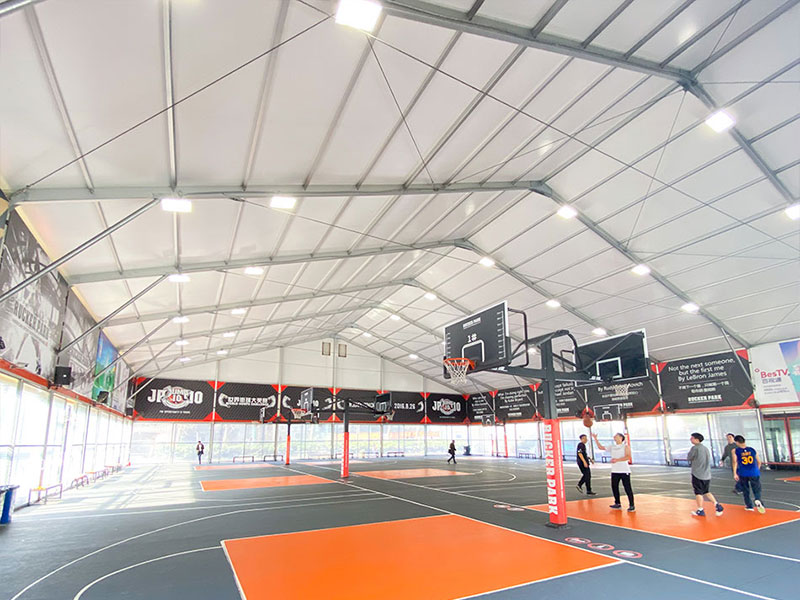
A: Temporary warehouses are fully customizable. Electrical systems, LED lighting, ventilation, and even climate control systems can be integrated seamlessly, providing the same functionality as a permanent building.
Q4: If my needs change, can I expand or relocate a temporary warehouse?
A: This is a primary advantage. The modular design allows for easy expansion by adding more bays. Furthermore, the entire structure can be disassembled and relocated to a new site, protecting your investment against future uncertainty.
Q5: How does the total cost of ownership (TCO) compare over 10 years?
A: While a permanent building may have a lower theoretical TCO over several decades, the temporary warehouse offers a superior TCO in the 5-10 year window due to minimal maintenance, no property taxes (as equipment), and the avoided cost of capital. The flexibility to adapt or relocate adds intangible value that isn't captured in simple cost models.
Conclusion and Strategic Recommendation
The choice between a temporary warehouse and a permanent building in 2026 is less about quality and more about financial strategy and operational philosophy. For logistics directors and factory owners who prioritize speed, capital preservation, flexibility, and a fast ROI, the evidence strongly supports the modern temporary warehouse solution.
Companies like Lingtong Structures have evolved the concept of the "temporary warehouse" into a sophisticated, high-performance asset. By providing clear-span aluminum structures that are quick to deploy, cost-effective, and durable, they enable businesses to scale operations responsively without the burden and risk of traditional construction. In an era defined by change, the ability to adapt your physical infrastructure as quickly as you adapt your business model is not just an advantage—it's a necessity.
Before committing to a multi-year construction project for a permanent building in 2026, savvy financial leaders are conducting a detailed temporary warehouse vs permanent building analysis. The result is increasingly clear: for rapid capacity expansion and optimal financial agility, the temporary warehouse is the strategic choice for the future.


Recent News
1.8 Key Advantages of Warehouse Tents You Should Know
2026-02-042.How Industrial Storage Tents Solve Global Warehousing Challenges?
2025-09-263.The 8 Types of Clearspan Tents For Long-Term Event Spaces
2025-08-214.What Material is Best for Tent Frames?
2025-08-075.How to Assemble Retractable Tents
2025-10-23