


 sales1@lingtong-structures.com








How to Choose a Retractable Tunnel for Industrial Storage and Outdoor Events
 Sep 16, 2026|
 View:796
When warehouse space runs short, you can rent a new warehouse or squeeze more usable space out of the existing site. The latter is often blocked not by lack of space but by lack of cover—materials sit exposed, and deterioration happens quietly. A retractable tunnel shelter opens when needed and closes when not, solving this specific problem and changing both its application range and selection logic. This article answers how to choose the right one: size, configuration, wheels versus tracks, and what to watch out for in different scenarios.
First, Determine Whether You Need a Walkway or a Storage Space
A retractable tunnel shelter serves two main functions. Before selecting a model, confirm which category you fall into. The rest of the decisions become much clearer.
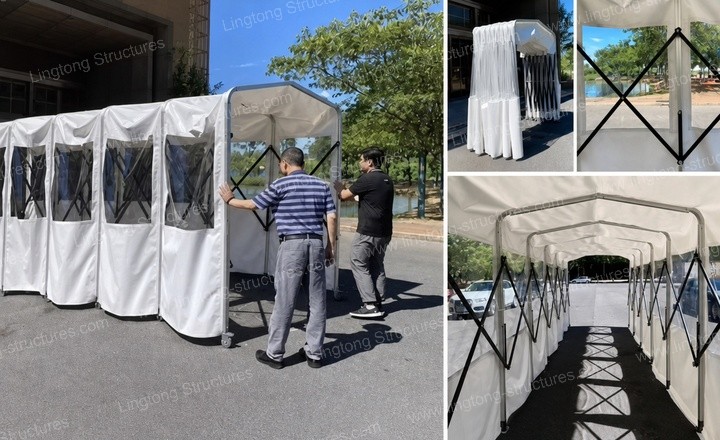
Walkway use. The core function is moving people or equipment. The tunnel itself is an enclosed passage. Common applications include connecting two buildings, player entry tunnels at stadiums, and pedestrian safety passages on construction sites. Walkway tunnels are typically narrow: spans between 2 and 5 meters, with heights around 2.2 to 3 meters for comfortable pedestrian movement.
Storage use. The core function is holding materials or covering equipment. The tunnel itself is a retractable storage space. Typical applications include temporary material storage at factories, forklift work area cover at logistics parks, and outdoor protection for large machinery. Storage tunnels require larger spans, usually between 5 and 15 meters, with a column-free interior to accommodate forklifts and oversized goods.
These two use cases demand completely different structural priorities. Walkway tunnels prioritize light weight and quick opening. Storage tunnels prioritize span and load capacity. Get this positioning clear first, then move on to specific parameters.
Industrial Storage: How to Set Span, Wheels, and Anchoring
Industrial storage is one of the most mature applications for retractable structures. A metal materials company needed to store large steel plates outdoors. They used a retractable tunnel shelter to cover the storage area, allowing forklifts to drive directly in and out. The structure was installed on hardstanding without permanent foundations, positioned by wheels.
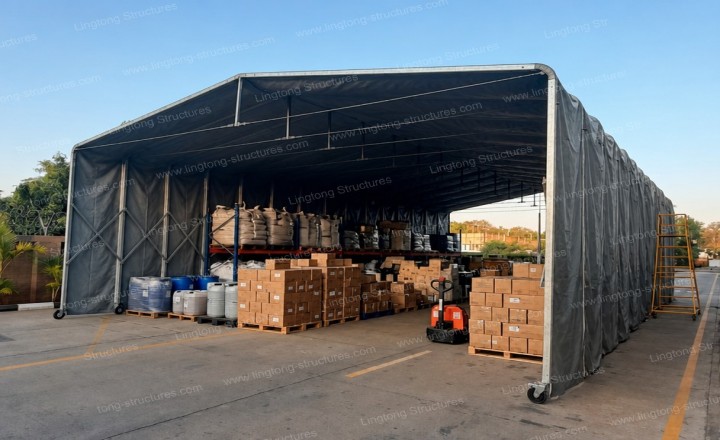
Three core selection parameters emerge from this type of project.
Span selection. Span determines what equipment and goods the tunnel can accommodate. Mainstream products range from 3 to 15 meters and can be customized to site conditions.
3 to 5 meters: forklift passages, small equipment cover, loading area protection
5 to 10 meters: temporary warehouse, raw material staging, medium equipment storage
10 to 15 meters: large equipment, vehicle parking, large-area temporary storage
If the site needs to accommodate multiple forklifts working simultaneously, or store oversized goods, the span should leave at least 1.5 to 2 meters of safety margin beyond the width of the goods.
Wheel configuration. This is the biggest structural difference between a retractable structure and a fixed tent. Every unit has wheels at the base—this is standard. The difference lies in the wheel type.
Nylon wheels are the most common configuration. They suit flat hardstanding (concrete, asphalt), with low rolling resistance and easy push-pull operation. Pneumatic tires suit slightly uneven ground or situations where small obstacles must be crossed. They offer better grip and smoother movement.
Track recommendation. Tracks are optional, not standard. The rule is simple: under 5 meters span, wheels alone are sufficient. Over 10 meters span, a track system is recommended. Tracks keep large-span structures from veering off course during movement. Large tunnels have significant self-weight and wind exposure. Without tracks, they tend to drift when pushed, causing seal misalignment and affecting both closure performance and service life. Tracks also ensure smooth operation on slightly uneven ground.
Anchoring. It does not need permanent foundations, but must be secured to the ground to prevent wind movement. On hard surfaces, ballast blocks or expansion bolts work. On soft ground, ground stakes with guy ropes are used. On sloped sites, additional anti-slip measures are required.
One often-overlooked risk: in long-term outdoor use, do not leave it in a partially open state. A half-open tunnel experiences uneven structural loading, which can damage wheels, seals, and frame components. Either fully extend and lock, or fully retract. This is one of the most common causes of premature damage in retractable structures.
Outdoor Events: Player Tunnels and Temporary Connection Passages
Retractable structures are widely used in sports venues, most notably as player entry tunnels. Ipswich Town FC uses a 14-meter player tunnel with a custom ground track system, providing full cover from the dressing room to the pitch.
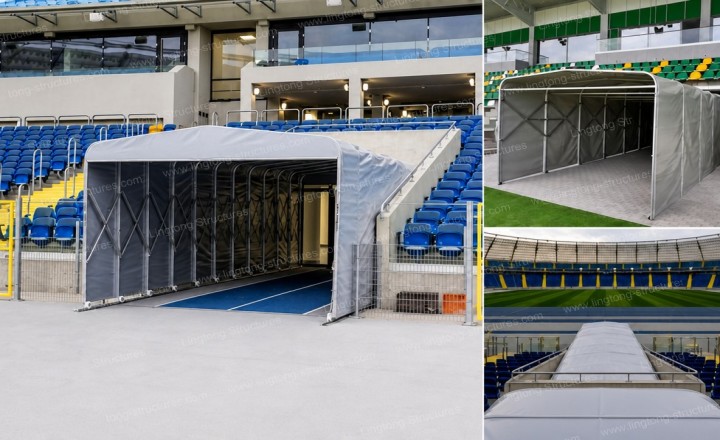
The selection logic for stadiums is completely different from industrial storage.
Branding is a core requirement. Player tunnels appear repeatedly in broadcast footage. The fabric can be printed with club crests, sponsor logos, and brand colors. The cover is replaceable, so a new season can bring a new visual identity without changing the frame.
Fast deployment is a key operational metric. Player tunnels are only extended on match days and training sessions. The rest of the time they stay retracted, taking up minimal space around the pitch. A well-designed system can go from fully retracted to fully enclosed in minutes.
Retracted volume determines storage convenience. Event venues are more sensitive to retracted footprint than industrial sites. A standard 10-meter system retracts to roughly 67 centimeters. Fleetwood FC's player tunnel is 8 meters long, 2 meters wide, and 2.6 meters high—retracted, it takes up only 60 centimeters.
Beyond player tunnels, retractable structures are used for event site connection passages, such as covered walkways from parking to entrance or backstage to stage. They are also used for spectator and VIP passages at sports events, and for temporary security or check-in enclosures.
Material and Configuration Baseline
Regardless of application, these structures share some common material standards.
Aluminum frame. Aluminum is lighter than steel. For a structure that needs frequent pushing and pulling, weight directly affects the operating experience. A unit one person can move is one that gets used. Aluminum also resists corrosion better than steel and does not need additional rustproofing for outdoor use. Mainstream aluminum frames have a service life of 15 to 20 years.
Industrial-grade PVC cover. Tunnel covers typically weigh between 650 and 850 g/m², double-coated, with waterproof, flame-retardant, and UV-resistant properties. The cover lasts 5 to 8 years and can be replaced independently while the frame remains in service.
Sealing is a key inspection point. Modules connect via sealing strips. The quality and installation precision of these seals determine waterproof and windproof performance. During acceptance, check that seals are flat, not lifting, and that joints fit tightly when modules are closed.
Six Things to Confirm Before Purchase
At the end of the selection process, put all parameters into a checklist and confirm each item before discussing a proposal with a supplier.
Usage frequency: daily, weekly, or occasional? Determines wheel type and track requirement.
Site dimensions and ground conditions: determines anchoring and foundation preparation.
Local wind and snow loads: determines profile specifications and structural design.
Primary use: people, goods, or vehicles? Determines span, height, and internal configuration.
Branding requirements: determines fabric printing and color scheme.
Retracted storage footprint: determines track and wheel system selection.
On budget: a retractable tunnel shelter costs slightly more upfront than a fixed tent of the same size, because of the moving mechanism and optional track system. But that difference should be viewed over the usage cycle. A fixed tent permanently occupies a piece of ground. A retractable tunnel shelter gives that space back when not in use. If your site is already tight on space, the value of that returned space may outweigh the cost difference.
Choosing the right one is not about picking a product—it is about choosing a way to use space. Fixed structures solve the "always needed" problem. Retractable structures solve the "sometimes needed" problem. Clarify your usage rhythm first, and the size and configuration decisions will follow.
If your site conditions and requirements are already clear, submit your dimensions, usage frequency, and ground conditions. We will prepare a tailored selection proposal for you.